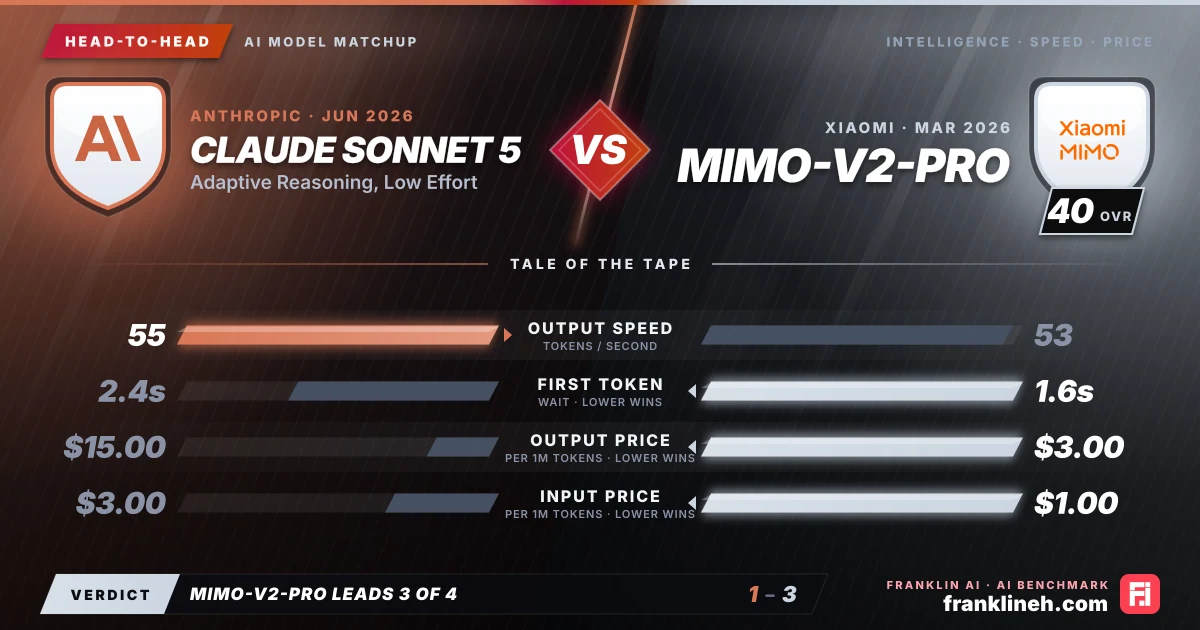
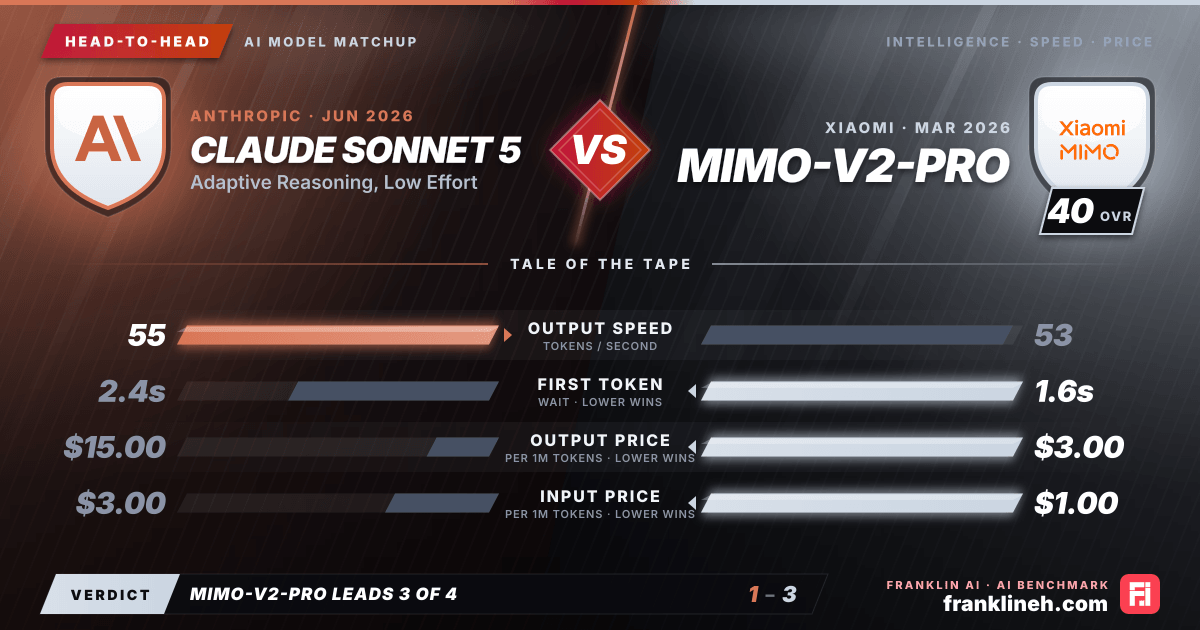
Head-to-head AI model comparison graphic: Claude Sonnet 5 (Anthropic) vs MiMo-V2-Pro (Xiaomi). Output speed 55 vs 53 tokens per second; time to first token 2.4s vs 1.6s; output price $15.00 vs $3.00 per million tokens; input price $3.00 vs $1.00 per million tokens. franklineh.com
Claude Sonnet 5 vs MiMo-V2-Pro: head-to-head AI benchmark comparison. MiMo-V2-Pro leads on time to first token, output price and input price; Claude Sonnet 5 leads on output speed.
Head to headUpdated

Claude Sonnet 5 vs MiMo-V2-Pro

Claude Sonnet 5 and MiMo-V2-Pro represent distinct approaches to AI deployment. While MiMo-V2-Pro offers transparent benchmark data and cost-efficiency, Claude Sonnet 5 provides a specialized, high-performance alternative backed by Anthropic’s expanding ecosystem of research and development tools.

Pick it for Claude Sonnet 5 · Adaptive Reasoning, Low Effort

  • Adaptive reasoning tasks
  • Anthropic ecosystem integration
  • Specialized research workflows

Pick it for MiMo-V2-Pro

  • Cost-sensitive applications
  • Scientific and technical analysis
  • Verified performance requirements

By the numbers

These figures describe the two model configurations shown here. A dash means the source snapshot had no usable figure for that metric. Scores, speed and API pricing may change as providers update models.

MetricClaude Sonnet 5 (Adaptive Reasoning, Low Effort)MiMo-V2-Pro
Intelligence Index–40.3
Input price (per 1M tokens)$3.00$1.00
Output price (per 1M tokens)$15.00$3.00
Output speed (tokens/s)5553
Time to first token2.4s1.6s
Release date2026-06-302026-03-18

Quick Take

Claude Sonnet 5 (released June 30, 2026) and MiMo-V2-Pro (released March 18, 2026) are two distinct AI models serving different market needs. Claude Sonnet 5 focuses on adaptive reasoning and low-effort tasks, while MiMo-V2-Pro provides a highly documented performance profile with clear benchmark data.

Benchmark Read

MiMo-V2-Pro offers a comprehensive look at its capabilities through several key benchmarks. It holds an Intelligence index of 40.3 and demonstrates strong performance in specialized areas: GPQA (0.87), HLE (0.283), SciCode (0.425), IFBench (0.688), LCR (0.607), TerminalBench Hard (0.409), and TAU2 (0.950). In contrast, Claude Sonnet 5 currently has no public benchmark rows available, making direct quantitative comparison difficult.

Cost and Speed

There is a significant price disparity between the two models. MiMo-V2-Pro is the more economical option, with a blended cost of $1.50/1M tokens (Input $1.00/1M, Output $3.00/1M). Claude Sonnet 5 is priced at a blended $6.00/1M (Input $3.00/1M, Output $15.00/1M).

Regarding performance, both models are competitive in speed. Claude Sonnet 5 achieves an output speed of 55.073 tok/s with a time to first token of 2.445s. MiMo-V2-Pro is slightly faster in initial response, with a time to first token of 1.574s and an output speed of 53.303 tok/s.

Best Fit

MiMo-V2-Pro is best suited for users who need verifiable performance data and cost-effective scaling. Its strong scores in benchmarks like GPQA and TAU2 suggest it is well-suited for technical and research-heavy tasks. Claude Sonnet 5 is best suited for users already embedded in the Anthropic ecosystem who require adaptive reasoning capabilities and integration with Anthropic’s specialized research tools.

Common questions about Claude Sonnet 5 Adaptive Reasoning and MiMo-V2-Pro

Is Claude Sonnet 5 Adaptive Reasoning better than MiMo-V2-Pro?

MiMo-V2-Pro leads on every measure the catalogue separates: MiMo-V2-Pro is 75% cheaper on blended price; and MiMo-V2-Pro reaches its first token sooner.

Who makes Claude Sonnet 5 Adaptive Reasoning and MiMo-V2-Pro?

Claude Sonnet 5 Adaptive Reasoning is made by Anthropic and MiMo-V2-Pro by Xiaomi. Claude Sonnet 5 Adaptive Reasoning was released on June 30, 2026 and MiMo-V2-Pro on March 18, 2026.

When were Claude Sonnet 5 Adaptive Reasoning and MiMo-V2-Pro released?

Claude Sonnet 5 Adaptive Reasoning is newer. It was released on June 30, 2026, about 3 months after MiMo-V2-Pro (March 18, 2026).

Which is faster, Claude Sonnet 5 Adaptive Reasoning or MiMo-V2-Pro?

Their output speeds are close: 55 tokens per second for Claude Sonnet 5 Adaptive Reasoning and 53 tokens per second for MiMo-V2-Pro. MiMo-V2-Pro reaches its first token sooner (1.6 seconds against 2.4 seconds).

Is MiMo-V2-Pro cheaper than Claude Sonnet 5 Adaptive Reasoning?

MiMo-V2-Pro is cheaper on a blended basis. Claude Sonnet 5 Adaptive Reasoning lists $3.00 per million input tokens and $15.00 per million output tokens; MiMo-V2-Pro lists $1.00 and $3.00. For 1 million input and 200,000 output tokens that is $6.00 against $1.60.

Final whistle

Choose MiMo-V2-Pro if you require a transparent, cost-effective model with verified performance metrics across scientific and coding benchmarks. Opt for Claude Sonnet 5 if your workflow integrates with Anthropic’s specialized research workbenches or if you prioritize the specific adaptive reasoning capabilities associated with the Claude ecosystem.

Where the numbers come from

The scores, speed and prices in this comparison come from independent third-party model evaluations that Franklin AI syncs each day, and the article was written from a snapshot of them. For the latest results, open the Claude Sonnet 5 (Adaptive Reasoning, Low Effort) and MiMo-V2-Pro pages. The AI Benchmark methodology explains how that data is collected and shown.

Comments (0)

No comments yet

Be the first to share your thoughts!