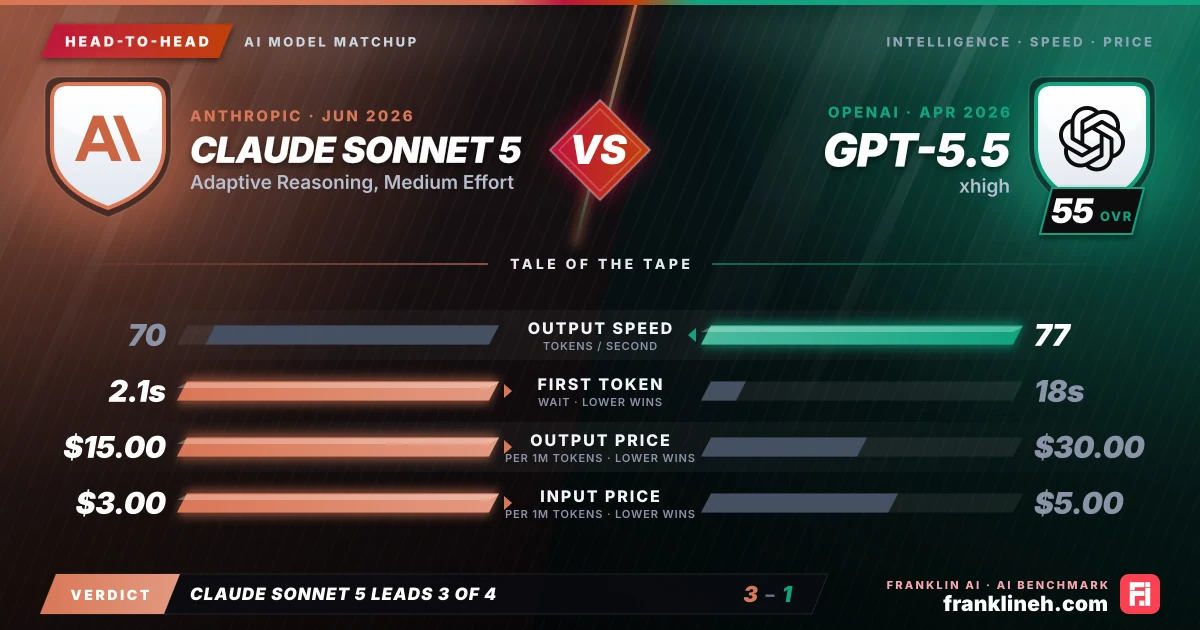
Claude Sonnet 5 vs GPT-5.5: head-to-head AI benchmark comparison. Claude Sonnet 5 leads on time to first token, output price and input price; GPT-5.5 leads on output speed.
Claude Sonnet 5 and GPT-5.5 (xhigh) represent the latest advancements from Anthropic and OpenAI. While GPT-5.5 offers extensive benchmark data and high performance, Claude Sonnet 5 provides a more cost-effective, rapid-response alternative for specific AI workflows.
Pick it for Claude Sonnet 5 · Adaptive Reasoning, Medium Effort
Cost-sensitive applications
Low-latency requirements
General adaptive reasoning
Pick it for GPT-5.5 · Xhigh
Complex coding tasks
Scientific research workflows
High-intelligence requirements
By the numbers
These figures describe the two model configurations shown here. A dash means the source snapshot had no usable figure for that metric. Scores, speed and API pricing may change as providers update models.
Claude Sonnet 5 (released June 30, 2026) and GPT-5.5 (xhigh) (released April 23, 2026) are the latest iterations from Anthropic and OpenAI. Claude Sonnet 5 focuses on adaptive reasoning with a medium-effort profile, while GPT-5.5 (xhigh) is positioned as a high-performance model with extensive documentation and benchmark validation.
Benchmark Read
GPT-5.5 (xhigh) provides a comprehensive look at its capabilities through a variety of standardized tests. It holds an Intelligence index of 54.8 and a Coding index of 74.9. Specific benchmark results include:
GPQA: 0.935
HLE: 0.443
SciCode: 0.561
IFBench: 0.758
LCR: 0.743
TerminalBench Hard: 0.606
TAU2: 0.938
Conversely, Claude Sonnet 5 currently has no benchmark rows available for comparison, making its performance profile more opaque compared to the data-rich GPT-5.5.
Cost and Speed
There is a significant difference in both pricing and latency between the two models:
Pricing: Claude Sonnet 5 is more affordable, with a blended cost of $6.00/1M tokens (Input: $3.00/1M, Output: $15.00/1M). GPT-5.5 (xhigh) is priced at a blended $11.25/1M (Input: $5.00/1M, Output: $30.00/1M).
Performance: Claude Sonnet 5 offers a faster time to first token at 2.069s, compared to 18.464s for GPT-5.5. However, GPT-5.5 (xhigh) maintains a higher output speed of 76.599 tok/s versus Claude’s 69.618 tok/s.
Best Fit
Claude Sonnet 5 is best suited for developers and businesses looking to minimize costs while maintaining low-latency interactions. Its adaptive reasoning capabilities make it a strong candidate for general-purpose tasks. GPT-5.5 (xhigh) is the superior choice for research, complex coding, and scientific applications where the model's performance must be verified against rigorous benchmarks like the newly introduced LifeSciBench.
FAQ
Is GPT-5.5 xhigh better than Claude Sonnet 5 Adaptive Reasoning?
Not across the board: Claude Sonnet 5 Adaptive Reasoning is 47% cheaper on blended price; GPT-5.5 xhigh streams output 1.1 times as fast; and Claude Sonnet 5 Adaptive Reasoning reaches its first token sooner.
Who makes Claude Sonnet 5 Adaptive Reasoning and GPT-5.5 xhigh?
Claude Sonnet 5 Adaptive Reasoning is made by Anthropic and GPT-5.5 xhigh by OpenAI. Claude Sonnet 5 Adaptive Reasoning was released on June 30, 2026 and GPT-5.5 xhigh on April 23, 2026.
When were Claude Sonnet 5 Adaptive Reasoning and GPT-5.5 xhigh released?
Claude Sonnet 5 Adaptive Reasoning is newer. It was released on June 30, 2026, about 2 months after GPT-5.5 xhigh (April 23, 2026).
Which model has lower latency?
GPT-5.5 xhigh generates output faster, at 77 tokens per second against 70 tokens per second. Claude Sonnet 5 Adaptive Reasoning reaches its first token sooner (2.1 seconds against 18 seconds). Counting the first-token wait, Claude Sonnet 5 Adaptive Reasoning finishes first for any reply shorter than about 13,000 tokens.
Which is cheaper, Claude Sonnet 5 Adaptive Reasoning or GPT-5.5 xhigh?
Claude Sonnet 5 Adaptive Reasoning is cheaper on a blended basis. Claude Sonnet 5 Adaptive Reasoning lists $3.00 per million input tokens and $15.00 per million output tokens; GPT-5.5 xhigh lists $5.00 and $30.00. For 1 million input and 200,000 output tokens that is $6.00 against $11.00.
Final whistle
Choose GPT-5.5 (xhigh) if your projects require high-level reasoning and verified performance metrics, as it excels in complex tasks like coding and scientific evaluation. Opt for Claude Sonnet 5 if you prioritize lower operational costs and faster initial response times, making it ideal for high-volume, latency-sensitive applications where extreme benchmark scores are less critical.

Comments (0)
to join the discussion
No comments yet
Be the first to share your thoughts!