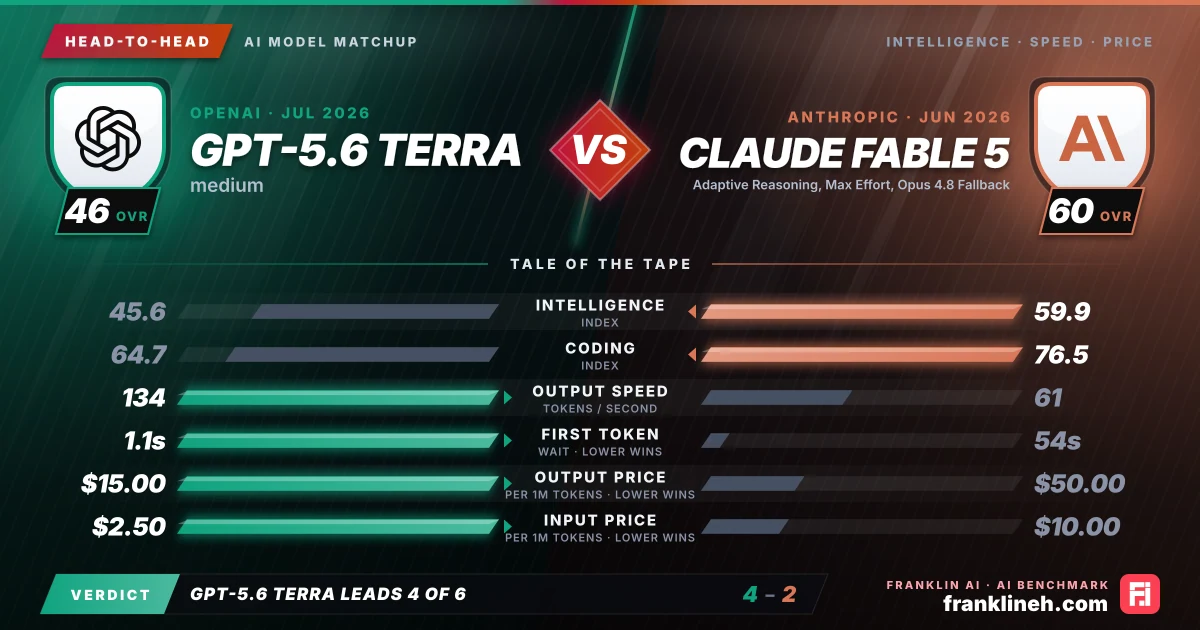
GPT-5.6 Terra vs Claude Fable 5: head-to-head AI benchmark comparison. GPT-5.6 Terra leads on output speed, time to first token, output price and input price; Claude Fable 5 leads on intelligence index and coding index.
GPT-5.6 Terra offers superior speed and cost-efficiency, while Claude Fable 5 provides higher intelligence and coding performance. Choosing between them depends on whether your priority is rapid, affordable output or maximum reasoning capability for complex, high-stakes tasks.
Pick it for GPT-5.6 Terra · Medium
High-volume production tasks
Budget-sensitive projects
Applications requiring low latency
Pick it for Claude Fable 5 · Adaptive Reasoning, Max Effort, Opus 4.8 Fallback
Complex reasoning and logic
Advanced coding requirements
High-stakes analytical work
By the numbers
These figures describe the two model configurations shown here. A dash means the source snapshot had no usable figure for that metric. Scores, speed and API pricing may change as providers update models.
OpenAI’s GPT-5.6 Terra and Anthropic’s Claude Fable 5 represent two distinct approaches to frontier AI. Released in July 2026, GPT-5.6 Terra focuses on high-velocity, cost-effective performance. Conversely, the June 2026 release of Claude Fable 5 prioritizes raw intelligence and complex reasoning, albeit at a higher financial and latency cost.
Benchmark Read
Claude Fable 5 consistently outperforms GPT-5.6 Terra across the provided metrics. Claude achieves an intelligence index of 59.9 compared to GPT-5.6’s 45.6. In coding, Claude scores 76.5 against GPT-5.6’s 64.7.
Benchmark performance follows this trend:
GPQA: Claude (0.926) vs. GPT-5.6 (0.872)
HLE: Claude (0.533) vs. GPT-5.6 (0.316)
SciCode: Claude (0.602) vs. GPT-5.6 (0.497)
TAU2: Claude (0.985) vs. GPT-5.6 (0.728)
LCR: Claude (0.7) vs. GPT-5.6 (0.68)
IFBench: Claude (0.635) vs. GPT-5.6 (0.622)
Cost and Speed
GPT-5.6 Terra is significantly more affordable, with a blended cost of $5.63/1M tokens compared to Claude Fable 5’s $20.00/1M. GPT-5.6 also excels in responsiveness, delivering 133.563 tokens per second with a time-to-first-token of 1.054 seconds. Claude Fable 5 is slower, outputting 60.571 tokens per second with a substantial 54.299-second delay before the first token appears.
Best Fit
GPT-5.6 Terra is best suited for high-volume applications where speed and budget are critical. Claude Fable 5 is the preferred choice for complex, reasoning-heavy tasks where precision is more valuable than immediate response times.
Common questions about Claude Fable 5 Adaptive Reasoning and GPT-5.6 Terra medium
Is Claude Fable 5 Adaptive Reasoning better than GPT-5.6 Terra medium?
Not across the board: Claude Fable 5 Adaptive Reasoning scores higher on the intelligence index, 59.9 to 45.6; GPT-5.6 Terra medium is 72% cheaper on blended price; and GPT-5.6 Terra medium streams output 2.2 times as fast.
Which is newer, Claude Fable 5 Adaptive Reasoning or GPT-5.6 Terra medium?
GPT-5.6 Terra medium is newer. It was released on July 9, 2026, 30 days after Claude Fable 5 Adaptive Reasoning (June 9, 2026).
How much do Claude Fable 5 Adaptive Reasoning and GPT-5.6 Terra medium cost?
GPT-5.6 Terra medium is cheaper on a blended basis. Claude Fable 5 Adaptive Reasoning lists $10.00 per million input tokens and $50.00 per million output tokens; GPT-5.6 Terra medium lists $2.50 and $15.00. For 1 million input and 200,000 output tokens that is $20.00 against $5.50.
Which model has lower latency?
GPT-5.6 Terra medium generates output faster, at 134 tokens per second against 61 tokens per second. GPT-5.6 Terra medium reaches its first token sooner (1.1 seconds against 54 seconds).
Which is better for coding, Claude Fable 5 Adaptive Reasoning or GPT-5.6 Terra medium?
Claude Fable 5 Adaptive Reasoning has the higher coding index, 76.5 against 64.7.
Final whistle
Choose GPT-5.6 Terra if you require high-speed, cost-effective performance for daily workflows. Select Claude Fable 5 if your projects demand the highest possible reasoning accuracy and coding proficiency, provided you can accommodate the higher price point and slower initial response times.

Comments (0)
to join the discussion
No comments yet
Be the first to share your thoughts!