
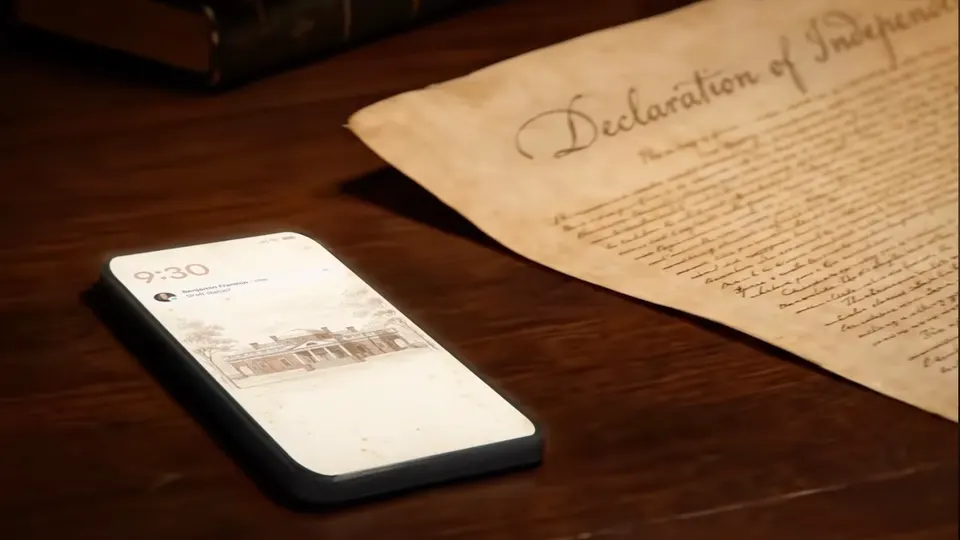
New Google commercial imagines a Declaration of Independence written with help from AI
Two hundred and fifty years after the signing of the Declaration of Independence, Google has released a new commercial that reimagines the historic event through the lens of modern technology. Titled "Group project, but make it 1776," the advertisement explores how the Founding Fathers might have navigated the drafting process if they had access to Google Workspace. The original reporting from techcrunch.com provides the source detail behind this update. To see google in practice, Google I/O 2026 Keynote in 13... walks through a concrete example.
A Digital Take on 1776
The commercial depicts a fictionalized version of Thomas Jefferson working on the document when he is interrupted by a text from Ben Franklin. The ad showcases a variety of Google tools, including Google Docs for suggested edits, Google Calendar for scheduling, and Google Meet for remote collaboration. In a humorous touch, the video shows every attendee in the virtual meeting with their cameras turned off. The process concludes with the use of e-signatures, followed by a celebratory display of fireworks. The ad also integrates Google’s AI capabilities into the narrative. The founders use the "help me visualize" tool to experiment with different animals for the national seal, while Gemini is utilized to take meeting notes and provide advice on declining King George III’s document access request. Despite these inclusions, the commercial avoids suggesting that AI should be used to write the actual text of the Declaration of Independence, a departure from previous Google advertising that drew criticism for its portrayal of AI-assisted writing. The Video Generation story also surfaces in Google Vids adds personalized AI avatars..., adding another angle.
Mixed Reactions to AI Evangelism
The reception to the commercial has been polarized across different platforms. While comments on YouTube and Instagram have been largely positive, the response on Bluesky has been notably critical. Many users on the platform described the ad as "cringey" and "tone deaf," with the AI integration serving as a primary point of contention. Historian Angus Johnston was among those who weighed in on the advertisement, noting that the content highlights the limitations of AI in professional and political contexts. "Even in a corny fantasy joke, it’s impossible to make the case that AI is a useful tool for political organizing, writing, or human collaboration," Johnston stated. Despite the heavy focus on AI features, some observers noted that the actual footage in the commercial carries an uncanny, AI-generated aesthetic. The AI Industry story also surfaces in Google to implement mandatory disclosure labels..., adding another angle.