
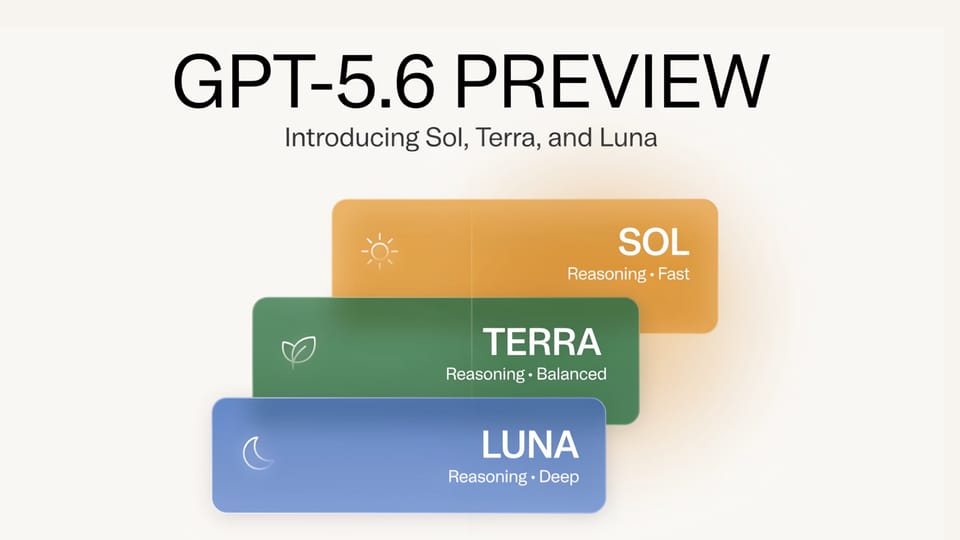
OpenAI has officially launched a limited preview of GPT-5.6, a next-generation model series that introduces a new structural approach to artificial intelligence deployment. Moving away from a single-model release, the GPT-5.6 family is categorized into three distinct, durable capability tiers: Sol, Terra, and Luna. This tiered system is designed to provide developers with clearer options regarding intelligence, speed, and cost, with each tier capable of advancing on its own independent schedule. The original reporting from marktechpost.com provides the source detail behind this update.
Tiered Capabilities and Performance
The Sol model serves as the flagship of the new series, representing OpenAI’s most powerful model to date with notable performance gains in coding, biology, and cybersecurity. The Terra tier is positioned for everyday production work, offering performance that matches the previous GPT-5.5 model while reducing costs by approximately half. Rounding out the lineup, Luna is designed as the fast, low-cost option for routine tasks. OpenAI has shared initial benchmark results highlighting the strength of the Sol model. On Terminal-Bench 2.1, which evaluates command-line workflows requiring planning and tool coordination, Sol achieved a score of 91.91% in its ultra reasoning mode. Furthermore, Sol demonstrated efficiency in specialized fields, outperforming GPT-5.5 on long-horizon genomics analysis via GeneBench v1 while utilizing fewer tokens.
New Reasoning Modes
GPT-5.6 introduces two new reasoning controls, max and ultra, which allow users to trade latency and cost for increased accuracy on complex, long-horizon problems. The max reasoning mode is designed to deepen a single chain of thought, providing the model with more time to process information. The ultra mode takes a different approach by leveraging subagents. Instead of relying on a single model, this mode coordinates multiple workers to split complex tasks, thereby accelerating the execution of multi-step processes. These controls are intended to assist in demanding use cases, such as multi-step CLI automation, vulnerability research, and complex file editing. The AI Models story also surfaces in OpenAI Unveils GPT-Red an Automated Model..., adding another angle. The same AI Agents question is explored in Scaling Large Reasoning Models beyond Human..., which adds a research perspective.
Access and Pricing Structure
OpenAI is currently providing access to the GPT-5.6 family through a limited preview for a small group of trusted partners via the API and Codex. The company noted that these models and plans were shared with the U.S. government prior to the preview. Broader access across ChatGPT, Codex, and the API is expected in the coming weeks. The pricing for the new models is structured per one million tokens. Sol is priced at $5 for input and $30 for output, matching the cost of GPT-5.5. Terra is priced at $2.50 for input and $15 for output, while Luna is the most accessible at $1 for input and $6 for output. Additionally, OpenAI has updated its prompt caching, which now supports explicit cache breakpoints and a 30-minute minimum cache life. Looking ahead, OpenAI plans to run the Sol model on Cerebras hardware, targeting speeds of up to 750 tokens per second starting in July. The AI Models story also surfaces in Kimi K3 DeepSeek V4 Pro and..., adding another angle.