
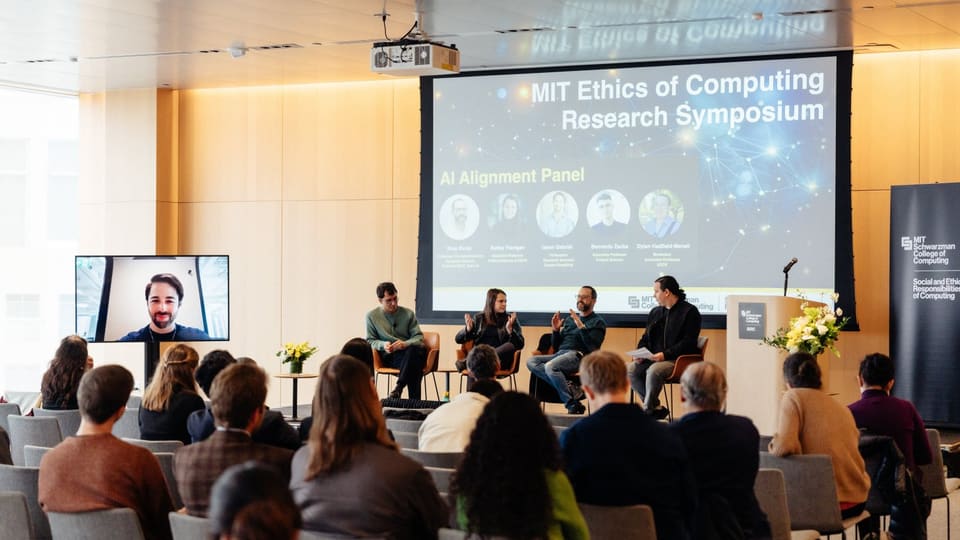
The MIT Schwarzman College of Computing’s Social and Ethical Responsibilities of Computing (SERC) initiative hosted a full-day research symposium on April 30, bringing together experts to examine the profound impact of artificial intelligence on society. The event highlighted the necessity of ensuring that technical progress and ethical reflection advance in tandem as AI becomes increasingly embedded in global infrastructure.
Aligning AI with Human Values
A central theme of the symposium was the challenge of AI alignment—the process of instilling human values into powerful, rapidly evolving technologies. During a panel moderated by Dylan Hadfield-Menell, associate professor of EECS, speakers debated the complexities of determining which values should guide these systems. Iason Gabriel of Google DeepMind suggested that AI should not be modeled as perfect, but rather as a tool that uses "character" to interpret moral values, similar to how a judge interprets rules.
Other panelists emphasized the governance and institutional dimensions of this issue. Bailey Flanigan, assistant professor of political science and EECS, identified the question of who is entitled to govern AI systems as a primary hurdle. Meanwhile, Bernardo Zacka, associate professor of political science, argued that a critical task is understanding the wisdom inherent in the existing systems that AI is currently replacing.
The Role of AI in Education
The symposium also addressed the integration of AI in classrooms, where faculty explored how to maintain academic rigor while utilizing new digital tools. Professors Eric Klopfer and Samuel Madden, co-chairs of MIT’s Ad Hoc Committee on AI Use in Teaching, Learning, and Research Training, expressed concern that students may use AI to offload work rather than to scaffold their learning. Madden noted that the "cognitive struggle" inherent in trial and error is essential for skill acquisition, a process that is bypassed when students rely on AI to solve problems immediately.
To address these challenges, panelists suggested that educators must move away from one-size-fits-all policies. Pat Pataranutaporn of the MIT Media Lab emphasized that AI should be designed to promote creativity and critical thinking, while Justin Reich, director of the Teaching Systems Lab, suggested that inviting students into the discussion regarding AI implementation could help them make more informed choices about how and why they use these tools.
Bridging the Gap Between Humans and Algorithms
In his keynote address, "AI’s Models of the World, and Ours," Jon Kleinberg, the Tisch University Professor of Computer Science and Information Science at Cornell University, discussed the risks of a mismatch between AI models and human reasoning. Using chess engines as an example, Kleinberg explained that while these systems can perform at superhuman levels, their strategies are often unintelligible to human partners.
This creates a dangerous "handoff" scenario where a human must take over a task without understanding the predictive logic the algorithm was following. Kleinberg’s analysis highlighted the fundamental difference between AI’s reliance on pattern recognition and the embodied, intuitive knowledge that defines the human experience. Ultimately, the symposium underscored that as AI continues to shape the world, the human component remains the most critical factor in ensuring these systems function safely and effectively.