
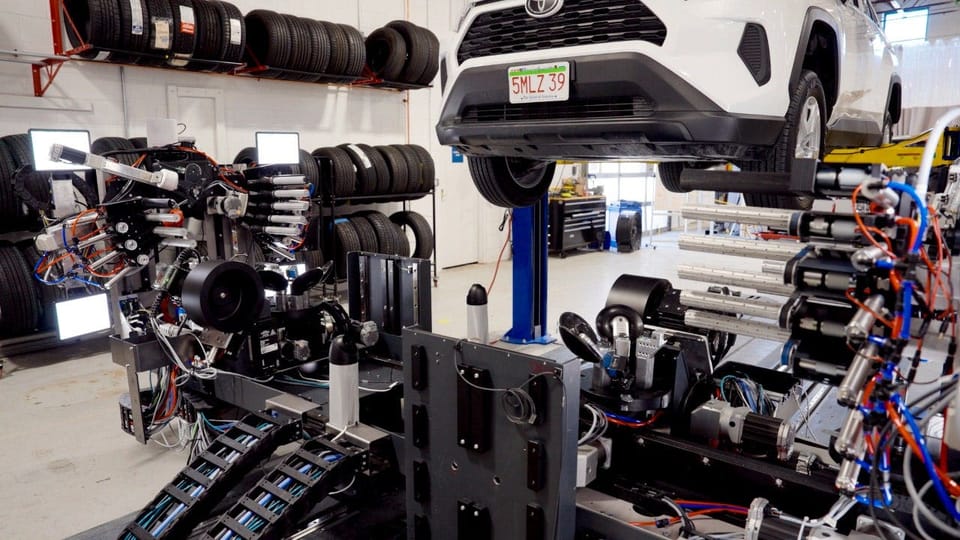
Automated Tire, Inc. has unveiled SmartBay, an AI-powered robotic platform designed to streamline tire changes, wheel balancing, and vehicle inspections. The Boston-based company developed the system to address persistent staffing shortages in automotive service centers and the increasing demand for tire maintenance driven by the rise of electric vehicles.
A New Approach to Tire Service
SmartBay utilizes physical AI, computer vision, and machine learning to perform tire work in real time. Unlike traditional methods that require technicians to manually remove wheels, SmartBay is a patented system that changes tires while the wheel remains on the vehicle. The car is lifted, and the system dismounts the tire directly from the rim. Following the installation of a new tire, the platform performs a "Real Force Balance," which balances the entire wheel-end assembly rather than just the tire itself.
According to Andy Chalofsky, CEO of Automated Tire, Inc., the system is designed to handle the physically demanding aspects of the job. While an operator provides light-touch oversight, the robot manages the heavy lifting and technical adjustments. The company notes that the equipment is designed to fit within a standard 12-foot service bay, allowing shops to integrate the technology without major infrastructure changes.
Efficiency and Workforce Impact
The system is intended to improve service speed and consistency. ATI reports that a single technician can manage up to three SmartBay-equipped service bays simultaneously, potentially increasing throughput from roughly four tires in 75 minutes to 24 tires per hour. Initial machines are targeting a 45-minute door-to-door tire change, with the potential to reduce that time to 30 minutes as the technology learns.
Regarding the role of human workers, the company suggests that the technology serves to augment the workforce rather than replace it. By automating repetitive, physically taxing tasks, the system aims to reduce the risk of strain injuries for technicians. This shift allows skilled mechanics to focus on more complex diagnostic and mechanical work, while shops can potentially increase the value and pay of operators who manage the robotic systems.
Adapting to Modern Vehicle Demands
SmartBay is built to adapt to a wide variety of vehicles, from standard passenger cars to heavy-duty trucks. Its AI layer processes hundreds of data points per vehicle to account for different models and road conditions, such as mud, salt, or brake dust. This adaptability is particularly relevant for electric vehicles, which often require more frequent tire replacements due to their weight and instant torque.
The platform also features a networked learning capability. Data gathered from a specific vehicle trim in one location can be used to train other machines across the network in near real-time. For drivers, the company expects the primary benefits to be more predictable scheduling and a more consistent, high-quality ride resulting from the precision of the automated balancing process.