
AI may have solved one of math’s biggest puzzles, raising controversy
OpenAI says it has found a finite-time “blowup” in the Navier–Stokes equations, suggesting that the equations used to describe fluid motion can break down under certain conditions. The result could resolve one of mathematics’ famous unsolved problems—but mathematicians are still examining the 166-page proof, while questions about credit and possible access to another team’s work have created controversy.
The Navier–Stokes existence and smoothness problem is one of seven Millennium Prize Problems selected by the Clay Mathematics Institute in 2000. Each carries a $1 million prize. OpenAI has said it will not claim the award for its result. as reported by Sciencenews The problem is not whether the equations are useful. They are central to science and engineering, including weather forecasting, ocean-current research and the design of aircraft, pumps and turbines. The question is whether their solutions always remain mathematically well-behaved—or whether they can produce an impossible-seeming event in which fluid speed becomes infinite.
What OpenAI says it found
Navier–Stokes equations describe how a fluid’s pressure, density and velocity change over time. They include viscosity, which represents a fluid’s resistance to flow. For most practical uses, the equations are powerful tools. Mathematicians, however, have not been able to establish whether smooth solutions always exist or whether they can develop singularities known as blowups.
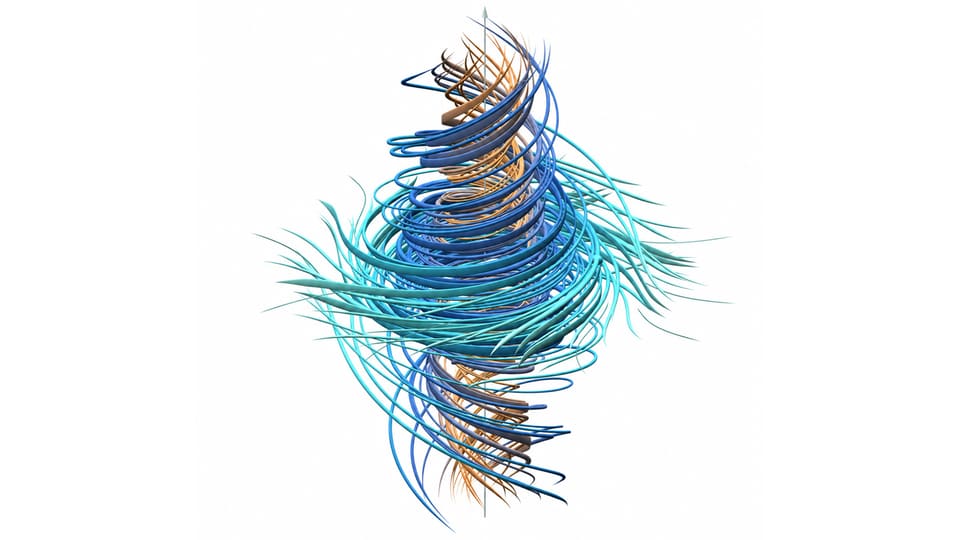
OpenAI researchers say their AI system found a solution to the forced version of the problem. In that scenario, an outside force acts on the fluid. The proposed solution involves a vortex that becomes progressively skinnier and faster as it spirals inward, with its speed eventually going to infinity.
That would mean the Navier–Stokes equations are not always well-behaved. In other words, the equations can describe a situation in which their own mathematical behavior breaks down in finite time.
The effort reportedly used around 10,000 AI agents at a time and cost millions of dollars to run, according to OpenAI researchers. The company said the result was verified using Lean, a tool designed to check complicated mathematical proofs. Still, formal verification by a computer is not the same as broad acceptance by mathematicians.
Gregory Eyink, a mathematical physicist at Johns Hopkins University, said no one had completely verified the proof on the human side. The paper is 166 pages long, leaving researchers to work through its details before they can fully assess the argument.
A closely related result intensified the dispute
The timing of the announcement has become an important part of the story. The day before OpenAI announced its Navier–Stokes result, mathematicians Tristan Buckmaster of New York University and Levent Alpöge of Anthropic reported a breakthrough on a related problem involving the Euler equations.
Euler equations resemble Navier–Stokes equations but omit viscosity. Because of that difference, they are often treated as a stepping stone toward understanding the more difficult Navier–Stokes problem.
Buckmaster and Alpöge found a blowup for the forced Euler equations, in which an outside force pushes on the fluid. Buckmaster described the result as a “Deep Blue-Kasparov moment,” referring to the milestone when a supercomputer defeated the leading human chess player. He also said the mathematical community needed a serious and unhurried discussion about what should happen next.
As the researchers were refining their work, rumors about the result began circulating. OpenAI researchers then started working on several Millennium Prize Problems before focusing on Navier–Stokes. The connection between the two efforts—and whether OpenAI had access to progress made by Buckmaster and Alpöge—has prompted intense speculation.
Buckmaster said he had discussions with OpenAI researchers about how the results should be presented. He alleged that one request involved excluding Alpöge, who works for OpenAI competitor Anthropic. OpenAI denies that its AI agents had direct access to the pair’s progress. The company has nevertheless said it cannot rule out the possibility that de-identified data derived from use of its products helped improve its models.
The dispute highlights a broader challenge for AI-assisted mathematics: determining who deserves credit when researchers, AI systems, verification tools and prior work all contribute to a result. OpenAI Unveils GPT-Red an Automated Model...
Why the mathematical answer may not change engineering
Even if the proof is accepted, the result is unlikely to alter how engineers use fluid equations in the near term. Eyink said the practical implications would be limited because real fluids are made of individual molecules and atoms, while the Navier–Stokes equations treat fluids as continuous substances.
That physical difference already implies a scale below which the equations no longer apply. The importance of the problem is therefore primarily mathematical and symbolic rather than a sudden change to weather forecasting, aircraft design or industrial fluid systems.
The prestige attached to the equations is substantial. Albritton called the problem one of the field’s guiding questions and said knowing the answer would be a major achievement. Eyink similarly described the equations as carrying “a huge mathematical celebrity.”
The proposed blowup would settle the long-running question in the negative: the equations do not always produce smooth, well-behaved solutions. But the claim still needs to survive close examination by human experts.
What to watch next
The immediate question is whether mathematicians can validate the proof in detail. Lean has confirmed the formal structure of OpenAI’s solution, but researchers are still digesting the paper and checking how its mathematical ideas fit together.
The other question concerns the standards for attribution in AI-assisted research. OpenAI’s use of thousands of agents marks a significant expansion in the scale at which AI can search through difficult mathematical problems. It also makes it harder to draw a simple line between independent discovery, assistance from models and knowledge that may have entered a system through earlier interactions.
The episode is part of a broader wave of AI results in mathematics. Over the past year, AI has enabled major advances, leaving mathematicians to grapple with how their field should respond. OpenAI researcher Sébastien Bubeck called the Navier–Stokes announcement the “spectacular culmination” of that progression.
Whether the proof ultimately becomes accepted as a solution to the Millennium Prize Problem, however, will depend on the slower process of mathematical review—and on how the community resolves the questions surrounding the work’s origins and credit.