
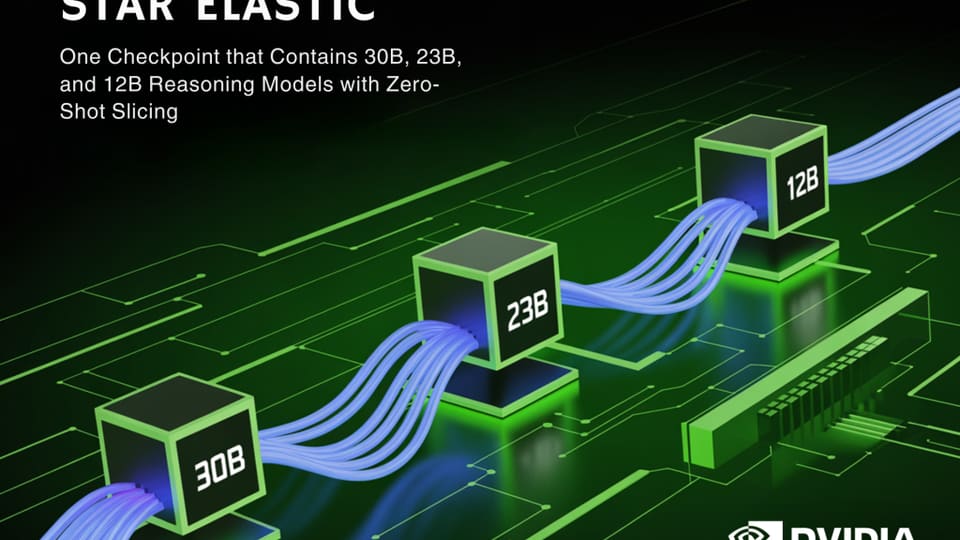
NVIDIA researchers have introduced Star Elastic, a post-training method that embeds multiple nested reasoning models of varying parameter budgets into a single parent checkpoint. By utilizing a single training run, this approach allows developers to access 30B, 23B, and 12B model variants without the need for separate training, storage, or deployment stacks. This technique achieves a 360-fold reduction in training costs compared to pretraining each variant from scratch and a 7-fold reduction over prior compression methods that require sequential distillation.
Nested Architecture and Dynamic Selection
The core of Star Elastic lies in its nested weight-sharing design, where smaller submodels are trained as subsets of the parent model. Using an importance estimation process, the system ranks components such as attention heads, Mamba heads, and MoE experts based on their contribution to accuracy. Smaller submodels are then constructed from the highest-ranked contiguous subsets of these components. Unlike traditional compression, Star Elastic employs an end-to-end trainable router that uses Gumbel-Softmax to select active components based on a target budget, allowing for differentiable architectural decisions.
This architecture enables a novel strategy for reasoning tasks: dynamic model selection. By using a smaller model for the initial thinking phase and a larger model for synthesizing the final answer, researchers achieved up to 16% higher accuracy and 1.9 times lower latency compared to standard budget control methods. This approach effectively balances the high-volume requirements of reasoning traces with the precision needed for final outputs.
Quantization and Deployment Efficiency
Star Elastic maintains its nested structure even when quantized, thanks to Quantization-Aware Distillation (QAD). This process preserves the nested mask hierarchy, allowing users to extract 23B and 12B variants from a single quantized checkpoint. For the 30B model, post-training quantization to FP8 recovers 98.69% of BF16 accuracy, while the NVFP4 format—which requires a short QAD phase—recovers 97.79% of accuracy. These optimizations significantly reduce memory footprints, with the 30B NVFP4 elastic checkpoint requiring only 18.7 GB of VRAM.
The efficiency gains are particularly notable for production environments. When deployed on an RTX Pro 6000, the 12B NVFP4 variant reaches 7,426 tokens per second, representing a 3.4-fold throughput improvement over the 30B BF16 baseline. Because the nested variants are contained within one checkpoint, developers can switch between model sizes or precision formats without the overhead of managing multiple independent files, making the system highly adaptable for diverse hardware constraints ranging from H100 GPUs to consumer-grade hardware like the RTX 5080.