
MIT Hackathon Team Builds Wearable AI That Moves Limbs
A six-person team at the MIT Hard Mode 2026 hackathon has developed Human Operator, a wearable prototype capable of moving a user’s hand and wrist through electrical muscle stimulation (EMS). The project, which secured the Learn Track win at the 48-hour event held at the MIT Media Lab, explores the intersection of embodied AI and human augmentation by using large multimodal models to trigger physical motor responses.
System Architecture and Operation
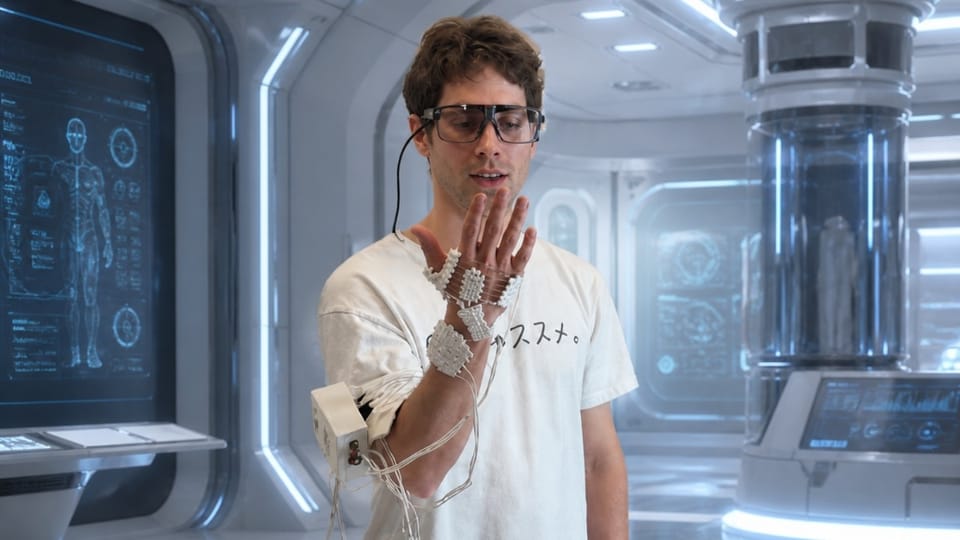
The Human Operator system functions by mapping spoken intent to physical movement. When a user provides a voice command, the system utilizes a head-mounted camera to capture the environment. This data is processed through a vision-language model pipeline connected to the Claude API. The model’s output is then transmitted to an Arduino-driven relay stack, which converts the digital instructions into specific EMS pulses. These pulses are delivered to electrodes placed on the user's fingers and wrist, resulting in short, model-directed movements.
The development team—comprising Peter He, Ashley Neall, Valdemar Danry, Daniel Kaijzer, Yutong Wu, and Sean Lewis—designed the prototype using accessible hardware, including a TENS/EMS unit and an Arduino microcontroller. The project repository and website provide build instructions and acknowledge foundational neuromuscular research conducted at the University of Chicago HCI Lab.
Technical Integration and Safety Considerations
The prototype represents an integration of sensing, planning, and low-level stimulation. By combining a vision-language model with an EMS actuator chain, the team created a system that maps high-level intent to discrete motor primitives. Because the system directly actuates human motion, the project highlights the necessity for careful calibration, per-channel timing control, and the implementation of safety protocols such as emergency-stop interlocks.
While the project serves as a proof of concept for embodied AI, it is framed by the team as an exploratory tool rather than a consumer product. The project homepage explicitly describes the effort as giving AI a body. For practitioners, the repository serves as a starting point for exploring sensor-actuator-model integration, though the nature of the technology invites ongoing discussion regarding safety, consent, and the handling of hardware failure in systems that interact directly with the human body.
Future Research and Evaluation
As an open-source hackathon project, Human Operator provides a foundation for further research into assistive interfaces. Technical observers and researchers are encouraged to monitor the project repository for replication attempts, safety notes, and community discussions regarding the limits of EMS control.
Future evaluations of such systems will likely focus on the publication of measured stimulation amplitudes, electrode maps, and closed-loop sensing logs. These artifacts are considered essential for assessing the risks and capabilities of combining model-driven control with body-actuating hardware. As the field of embodied AI advances, projects like Human Operator continue to provide a practical, albeit provocative, look at how multimodal models can be leveraged to bridge the gap between digital reasoning and physical action.