
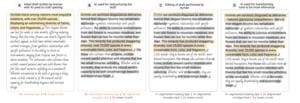
As generative artificial intelligence becomes a staple of the college writing experience, researchers from the Georgia Institute of Technology and Stanford University have developed a new open-source tool called DraftMarks. Rather than attempting to detect the presence of AI, the tool makes the collaborative writing process visible, allowing educators to see how students interact with AI throughout the drafting phase.
Visualizing the Writing Process
DraftMarks functions as an augmented reading tool that overlays visual cues onto a document to represent different types of AI involvement. By using a visual language that mimics physical writing artifacts, the tool provides immediate context for how a piece of text evolved. For instance, "eraser crumbs" indicate heavily revised passages, while "smudges" signal AI-generated changes to the strength of an argument. Other markers include "masking tape" for AI-generated passages, "glue residue" for removed AI text, and "ghost text" for prompts that were ultimately rejected by the writer.
These marks are designed to tell a story about the writer’s process. By tracking a document’s history and classifying edits in near real-time, the tool helps both students and instructors identify whether a writer is engaging critically with AI or simply accepting its output passively.
Designing for Educational Insight
The development of DraftMarks began with a focus on the needs of educators. In an initial study involving 21 participants, researchers observed how instructors assess student learning, revision, and originality. This feedback informed the tool’s design, ensuring that the visual cues align with the methods teachers already use to evaluate student work.
Adam Coscia, a computing Ph.D. student involved in the project, noted that these marks help teachers and students see the effort behind a piece of writing. By making the invisible parts of the process tangible, the tool encourages students to make more intentional judgment calls regarding their collaboration with AI.
Shifting Toward Transparency
The research team debuted DraftMarks in April at the Association for Computing Machinery’s Conference on Human Factors in Computing Systems in Barcelona. A follow-up study with 70 participants—including students, teachers, and journalists—revealed that the tool serves different purposes for different audiences. While instructors used the marks to evaluate the development of ideas and student judgment, general readers utilized them to assess authorial intent and trust.
Unlike traditional AI detection software, which often provides only a binary percentage of AI usage, DraftMarks is intended to prompt reflection. By revealing how AI influences tone and content, the tool aims to shift the academic conversation away from simple detection and toward greater transparency in the era of human-AI collaboration.