
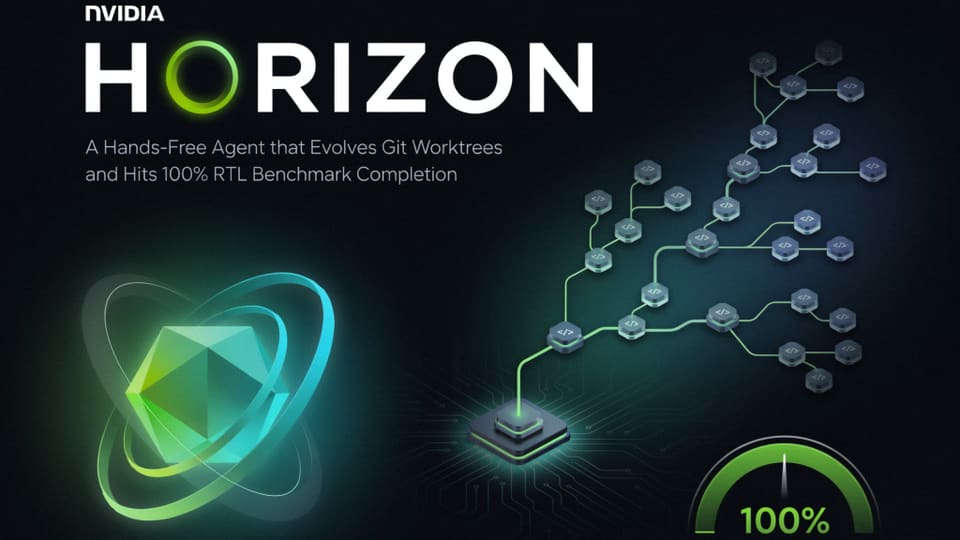
NVIDIA Research has introduced HORIZON, a hands-free agent framework designed to automate hardware engineering by treating register-transfer level (RTL) design as a process of repository-level code evolution. Unlike traditional single-turn code generation models that struggle with the complexities of hardware design, HORIZON operates within an isolated git worktree. It iteratively refines designs until they satisfy an executable acceptance gate, achieving a 100% completion rate across every evaluated RTL benchmark suite. The original reporting from marktechpost.com provides the source detail behind this update.
A Repository-Level Approach to Hardware Design
The framework moves beyond the limitations of one-shot prompts by hosting each design problem as a version-controlled repository. Users provide a structured Markdown harness containing four essential components: a clear goal, domain-knowledge directions, an evaluator specification, and an acceptance predicate. Once bootstrapped, the agent functions autonomously, planning targets, editing the worktree, and invoking tools to run evaluations. Git serves as the core substrate for this process, providing a transparent history of the design trajectory. Each successful attempt is committed to the repository, with evaluator evidence attached via git notes. This history acts as an experience buffer, allowing the agent to learn from both successful repairs and logged failures without requiring updates to the underlying model policy. By leveraging session reuse and prompt caching, the system maintains efficiency, with approximately 91% of tokens being cached input.
Benchmark Performance and Practical Application HORIZON was evaluated using the GPT-5.3 backbone across several benchmark suites, including ChipBench, RTLLM-2.0, Verilog-Eval, and nine categories from the CVDP dataset. The results demonstrate the agent's capability to handle diverse hardware tasks, ranging from RTL code completion and natural-language specification implementation to verification generation and bug fixing.
While the aggregate first-iteration pass rate was 47.8%, the agent consistently reached 100% completion across all suites through iterative refinement. The same question is explored in Verify Smarter, Evolve Further, which adds a research perspective.
The research team noted that convergence difficulty varies significantly by task. For instance, while some benchmarks reached full completion within two iterations, others, such as code completion tasks, required up to 82 iterations. Despite these successes, the researchers emphasize that agentic hardware design is not yet a solved problem. Current limitations include the potential for reward hacking, where an agent might satisfy the visible harness without meeting the full underlying specification, and the lack of optimization for synthesis quality-of-results. If you want to see this workflow in practice, Ego Lite is a useful comparison.
Future Directions for Self-Evolving Systems HORIZON builds upon a lineage of self-evolving systems, such as AlphaEvolve and SATLUTION, by applying the principle that candidate changes should only be admitted when supported by executable evidence. By focusing on RTL sources, testbenches, and verification artifacts, the framework provides a scalable protocol for generation and repair.
Moving forward, the research team proposes a two-level protocol for future benchmarks to address current limitations. This approach would involve exposing diagnostic feedback during the repair phase while reserving hidden randomized tests, reference models, and formal checks for final scoring. By shifting the focus toward token efficiency and more rigorous evaluation, HORIZON establishes a foundation for more robust, automated hardware development workflows.