
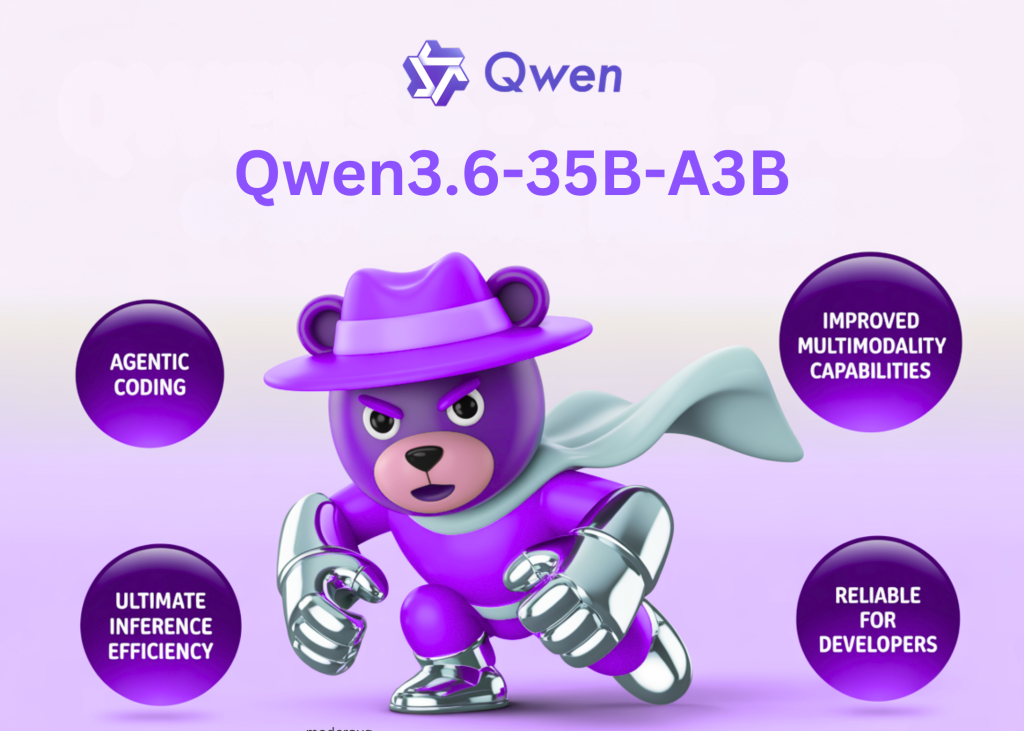
The Qwen team at Alibaba has officially released Qwen3.6-35B-A3B, a powerful new open-source model that redefines the balance between parameter efficiency and performance. Released under the Apache 2.0 license, this multimodal, agentic model utilizes a sparse Mixture of Experts (MoE) architecture. While the model contains 35 billion total parameters, it activates only 3 billion during inference, allowing for high-level performance while maintaining the compute efficiency of a much smaller model.
Architectural Innovation and Efficiency
The model’s efficiency stems from its sophisticated MoE design, which routes input tokens through a small subset of specialized sub-networks rather than activating the entire parameter set. Qwen3.6-35B-A3B features 256 total experts, with 8 routed experts and 1 shared expert activated per token. The architecture is built across 40 layers, utilizing a pattern of Gated DeltaNet for linear attention and Gated Attention with Grouped Query Attention (GQA) to manage memory pressure.
This design supports a native context length of 262,144 tokens, which can be extended up to 1,010,000 tokens using YaRN scaling. By utilizing GQA with 16 attention heads for queries and only 2 for keys and values, the model significantly reduces KV-cache memory requirements, making it a highly capable tool for resource-constrained environments when paired with frameworks like KTransformers.
Agentic Coding and Reasoning Capabilities
Qwen3.6-35B-A3B demonstrates significant advancements in agentic coding and complex reasoning. On the SWE-bench Verified benchmark, the model achieved a score of 73.4, and it secured the top position on Terminal-Bench 2.0 with a score of 51.5. Its performance in frontend code generation is particularly notable, scoring 1397 on QwenWebBench, which covers categories ranging from web apps and games to data visualization.
Beyond coding, the model excels in academic and scientific reasoning. It recorded a score of 92.7 on AIME 2026 and 86.0 on the GPQA Diamond graduate-level benchmark. These results indicate that the model’s sparse architecture does not compromise its ability to handle complex, multi-step logical tasks.
Multimodal Performance and Thinking Control
As a natively multimodal model, Qwen3.6-35B-A3B processes images, video, and documents with high precision. It outperformed models like Claude-Sonnet-4.5 and Gemma4-31B on benchmarks such as MMMU, where it scored 81.7, and RealWorldQA, where it achieved 85.3. Its spatial and video understanding capabilities are further evidenced by a score of 83.7 on VideoMMMU.
The model also introduces refined control over reasoning through a new Thinking Preservation feature. By default, the model operates in a thinking mode, generating reasoning traces within tags. Developers can now opt to preserve these traces across historical messages, which enhances decision consistency and efficiency in multi-step agent workflows. Mode switching and preservation settings are managed through API parameters, providing a streamlined experience for developers integrating the model into existing pipelines.