
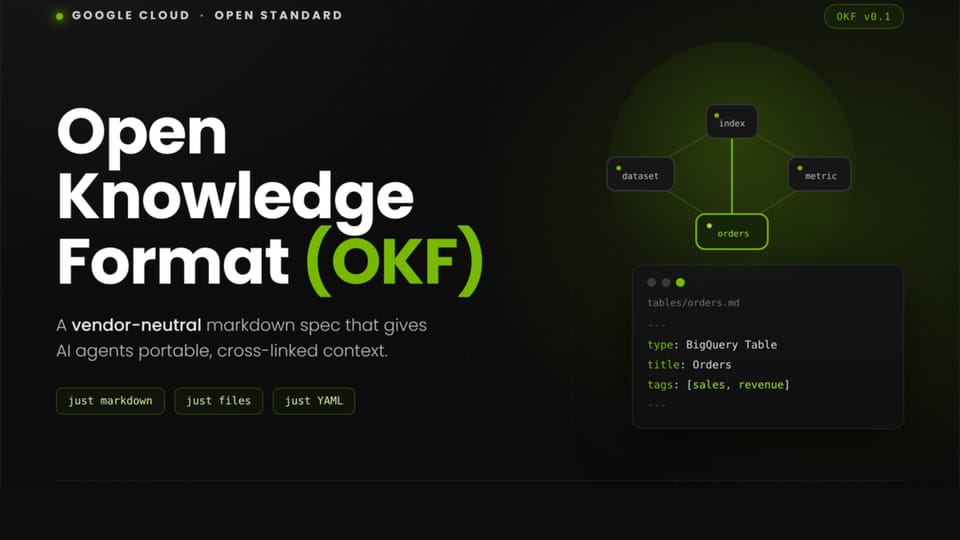
Google Cloud has introduced the Open Knowledge Format (OKF), an open specification designed to standardize how AI agents access and utilize curated context. By formalizing the LLM-wiki pattern into a portable, interoperable format, OKF addresses the challenge of fragmented internal knowledge—such as table schemas, metric definitions, and runbooks—that currently resides in incompatible silos like wikis, catalogs, and code comments.
A Vendor-Neutral Standard for AI Context
OKF is a format rather than a service or platform, requiring no proprietary SDK, runtime, or compression scheme. Version 0.1 of the specification represents knowledge as a directory of markdown files enhanced with YAML frontmatter. Because the format relies on standard markdown conventions, OKF bundles are human-readable, renderable on platforms like GitHub, and can be mounted on any filesystem. This design ensures that knowledge curated by one producer can be consumed by an agent from a different provider without the need for translation.
The specification is built on three core principles: it is minimally opinionated, requiring only a type field for each concept; it ensures producer and consumer independence; and it remains strictly a format rather than a platform. By avoiding ties to specific cloud providers, databases, or agent frameworks, OKF provides a stable, vendor-neutral layer for organizing information.
Structuring Knowledge as a Graph
In an OKF bundle, each concept—such as a dataset, metric, or playbook—is stored as an individual file where the file path serves as its unique identity. The YAML frontmatter allows for structured metadata, including titles, descriptions, and resource links, while the markdown body provides the descriptive content. Concepts can be linked to one another using standard markdown links, effectively turning a directory of files into a rich knowledge graph that exceeds simple parent-child relationships.
This approach offers a distinct alternative to Retrieval-Augmented Generation (RAG). While RAG systems typically derive knowledge at query time from raw, unstructured chunks, OKF stores curated, cross-linked, and version-controlled concepts. This allows agents to read and update the knowledge directly, mirroring the way humans manage personal wikis but with the efficiency and consistency of an automated system.
Practical Applications for Development Teams
The utility of OKF spans several technical use cases, including metadata-as-code for data teams, where table and metric definitions can be committed alongside SQL code and managed via pull requests. It also serves as a framework for incident runbooks, enabling agents to navigate complex join paths and documentation to resolve issues. Furthermore, it facilitates cross-organizational knowledge exchange, allowing vendors to ship catalog exports that agents can consume immediately without integration work.
To support the adoption of this standard, Google Cloud has released reference tools, including a BigQuery enrichment agent, a static HTML visualizer, and several sample bundles. Because the format is parseable with standard tools, developers can build their own integrations to read and serve these bundles without needing a backend or specialized infrastructure.