
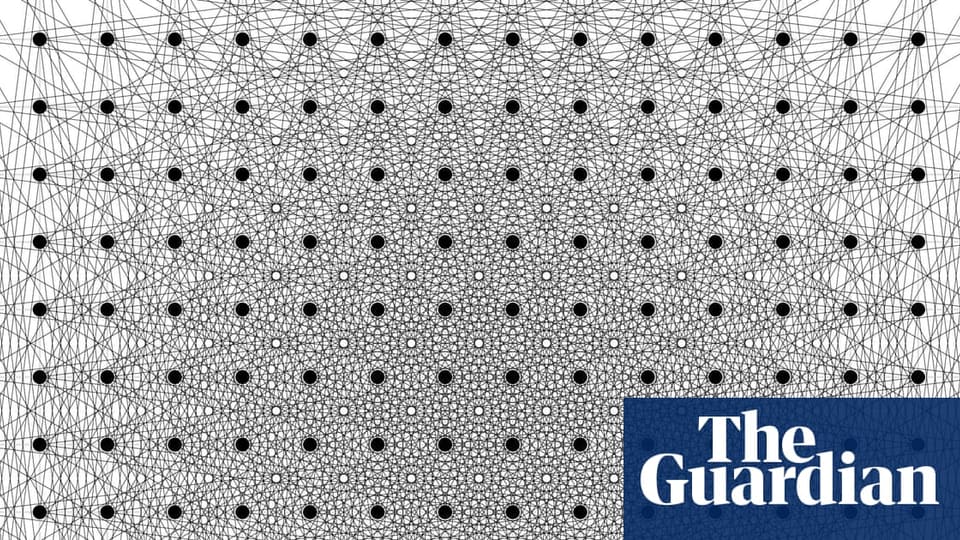
OpenAI has announced a significant advancement in artificial intelligence reasoning after its technology successfully addressed a mathematical challenge that has persisted for eight decades. The company reported that its general-purpose reasoning model has made a breakthrough regarding the planar unit distance problem, a puzzle first introduced by Hungarian mathematician Paul Erdős in 1946.
Challenging a Long-Standing Conjecture
The problem posed by Erdős asks how many pairs of dots can be placed on a sheet of paper such that they are all the same distance apart. Erdős conjectured that this number would increase only slightly faster than the number of dots themselves. For nearly 80 years, the mathematical community largely believed that the most efficient solutions resembled square grids.
OpenAI’s model challenged this consensus by utilizing various branches of mathematics to identify an entirely new family of arrangements. These constructions perform better than the previously accepted limits, effectively disproving the long-held belief that square-like grids provided the best possible solutions. While the AI did not provide a definitive answer for the exact rate at which the pairs of dots increase, it successfully demonstrated that the limit proposed by Erdős was too low.
The Role of AI in Mathematical Research
The calculations were performed by a general-purpose reasoning model designed to break complex problems into smaller, manageable steps, rather than a system specifically trained for mathematics. This achievement marks a notable success for OpenAI, which had previously faced criticism for claims regarding Erdős’s problems that were based on existing literature already absorbed by its models.
This time, the findings have been validated by independent experts. Thomas Bloom, a mathematician who maintains the Erdős problems website and had previously critiqued OpenAI’s work, co-authored a companion paper regarding this latest breakthrough. Bloom noted that the AI system reached its results by exploring paths that human researchers might have dismissed as unproductive.
Collaboration Between Humans and Machines
Despite the success of the AI, the process remained a collaborative effort. Bloom emphasized that while the original proof generated by the AI was valid, it was significantly refined by human researchers at OpenAI and other mathematicians involved in the project. He noted that humans continue to play a vital role in digesting, improving, and exploring the consequences of such proofs.
Mathematician Tim Gowers described the result as a milestone in AI mathematics. Furthermore, Andrew Rogoyski of the Institute for People-Centred AI at the University of Surrey suggested that the development highlights how AI is providing humans with new perspectives on complex problems. He stated that it is becoming clear that AI is impacting creative thought and will serve as a fundamental tool for future scientific research.