
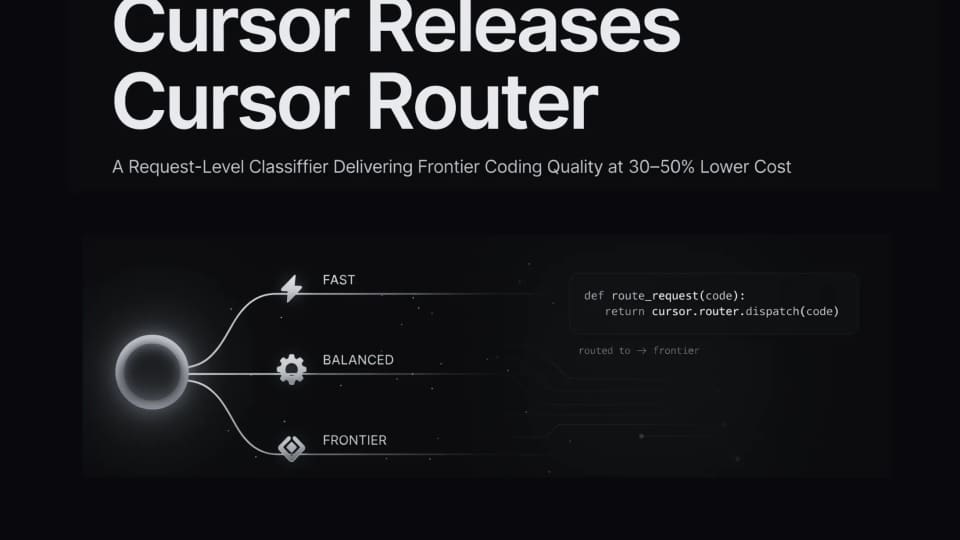
Cursor has announced the general availability of Cursor Router for Teams and Enterprise plans, a sophisticated request-level classifier designed to optimize AI coding workflows. By analyzing each request before model execution, the system dispatches tasks to the most appropriate model, effectively balancing high-end performance with significant cost reductions. According to Cursor, the system delivers frontier-quality output while achieving 30–50% savings for early-access enterprise accounts and up to 60% savings in online A/B tests. The original reporting from marktechpost.com provides the source detail behind this update.
Intelligent Routing for Coding Tasks
Cursor Router addresses a common inefficiency in developer workflows where users rely on a single, high-cost model for all tasks, regardless of complexity. The classifier is trained on over 600,000 live requests and evaluates four key inputs: the query, context, task complexity, and domain. Based on this analysis, the router follows three primary rules: simple tasks are directed to price-efficient models, UI updates are sent to models with superior aesthetic taste, and complex, long-horizon problems are handled by frontier reasoning models. Crucially, the system is cache-aware. Because switching models mid-conversation can invalidate prompt caches and incur additional costs, the router includes these potential cache-miss expenses in its training and evaluation metrics. This ensures that the reported savings reflect real-world usage rather than theoretical performance. The Developer Tools story also surfaces in NVIDIA DeepStream 9.1 Adds Agentic Skills..., adding another angle.
Evaluation Through Real-World Usage
Rather than relying on offline evaluations, which Cursor notes often suffer from small sample sizes and a lack of real-world context, the team utilized online A/B testing across millions of live requests. The router’s performance is measured by two primary metrics: user satisfaction, determined by whether a user accepts the agent's output or provides corrections, and the keep rate, which tracks how much generated code remains in the codebase over time. These metrics have been used to evaluate model launches and harness improvements for the past nine months. By focusing on these indicators, Cursor aims to align its routing decisions with actual developer productivity and satisfaction rather than static benchmarks. The AI Models story also surfaces in Google AI Launches TabFM for Zero-Shot..., adding another angle.
Optimization Modes and Deployment
Cursor Router introduces three optimization settings within its Auto mode, allowing teams to navigate the cost-intelligence Pareto frontier. Auto Intelligence provides performance comparable to top-tier models at a 60% lower cost for teams, while Auto Balance offers a higher user satisfaction rate than Opus 4.8 at approximately 36% lower cost. When measured by cost per commit, Auto Balance averages $4.63, compared to $7.34 for Opus 4.8 and $12.69 for Fable 5. The system is now available across desktop, web, iOS, CLI, and the Cursor SDK. For Enterprise admins, the dashboard provides granular control over the implementation, including the ability to set default modes, restrict member selections, and manage model allow and block lists. A notable constraint for procurement is that Grok 4.5 is a required routing option for price-efficient tasks, and billing for the Balance and Intelligence modes is calculated based on the specific rate of the model selected for each request. The Developer Tools story also surfaces in Andrew Ng Launches OpenWorker to Deliver..., adding another angle.