
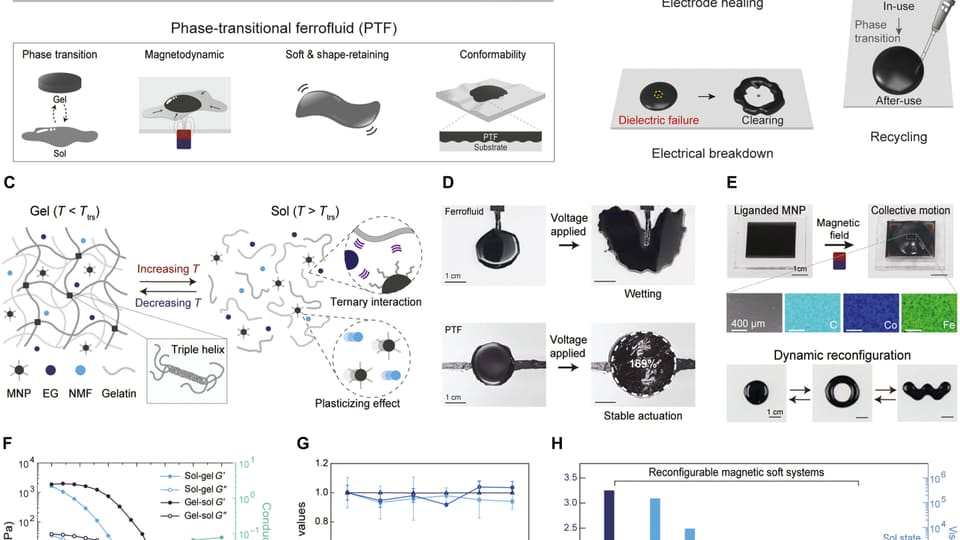
Researchers at Seoul National University have developed a next-generation artificial muscle capable of real-time shape reconfiguration, self-healing, and sustainable reuse. By utilizing a phase-transitional ferrofluid (PTF), this new class of soft actuator overcomes the limitations of conventional robots, which are typically restricted to predefined, static functions once fabricated. The study, published in Science Advances, marks a significant shift toward adaptive, programmable robotic systems.
A Dynamic Approach to Soft Robotics
Dielectric elastomer actuators (DEAs) function as soft transducers that convert electrical energy into mechanical motion, often mimicking the rapid and precise movements of human muscles. Historically, these systems have been constrained by fixed electrode patterns, requiring manufacturers to design and build entirely new robots whenever a task or environment changes. This limitation has created significant inefficiencies and high costs in the development of versatile soft robotics.
The new PTF-based electrode solves this by behaving as a solid at room temperature while transitioning into a flexible, fluid-like state when exposed to heat or magnetic fields. This allows the electrode to dynamically split, merge, and adjust its position in three-dimensional space even after the robot has been fabricated. Consequently, a single actuator can be reconfigured to perform entirely different motions, such as bending or expansion, in response to the specific needs of a task.
Resilience and Sustainability
Beyond its reconfigurability, the PTF electrode offers robust self-healing capabilities. If the material is severed by a sharp object or suffers an electrical breakdown due to high voltage, the system can convert the electrode near the damaged area into a liquid state to reconnect the circuit or bypass the failure. This ensures that the robot remains functional despite physical or electrical damage.
The design also prioritizes environmental sustainability. At the end of a device's lifespan, the electrode material can be extracted in liquid form, stored, and reused in new robotic systems. Researchers demonstrated that the material maintains a high recovery rate of approximately 91% even after multiple cycles of reuse, offering a new paradigm for resource circulation in the electronics and robotics industries.
Future Implications for Adaptive Systems
The research team, led by Professors Jeong-Yun Sun and Ho-Young Kim, views this technology as a foundation for "living, programmable elements" in robotics. By integrating advanced materials engineering with mechanical systems, the team has demonstrated that a single robotic structure can achieve virtually limitless modes of motion.
This breakthrough has broad potential applications, ranging from advanced artificial muscles that replicate complex human movements to smart robots capable of self-repair in extreme industrial environments. Furthermore, the ability to dynamically alter shape and information could lead to next-generation displays that adapt their form in real time.
Source: Slime-like artificial muscle reshapes on command, heals after damage and turns one robot into many (https://techxplore.com/news/2026-04-slime-artificial-muscle-reshapes-robot.html)