
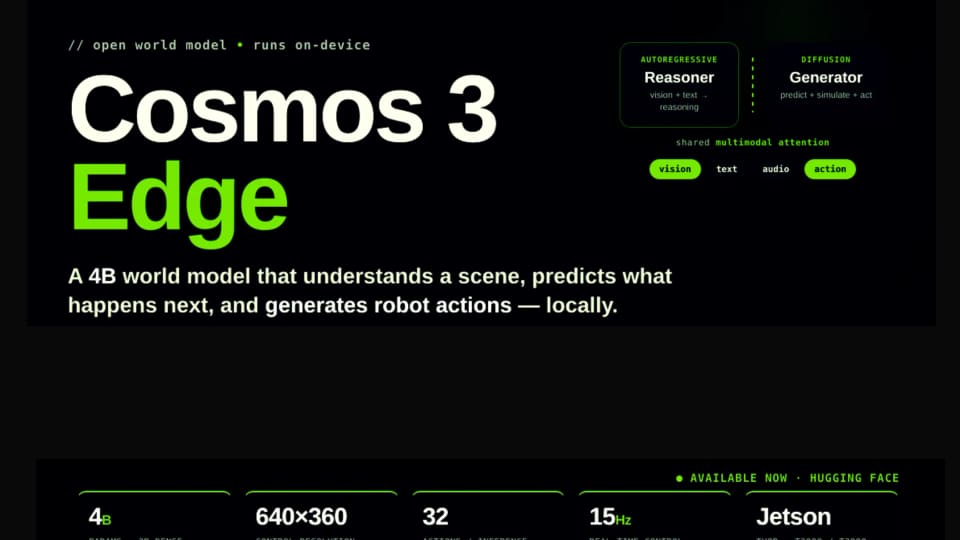
NVIDIA has officially released Cosmos 3 Edge, a 4-billion-parameter open world model designed specifically to run on-device. This new model enables robots and vision AI agents to process their surroundings, perform real-time reasoning, and generate physical actions locally. As the third and smallest tier in the Cosmos 3 family—following the Cosmos 3 Nano and Cosmos 3 Super released on May 31, 2026—the Edge model provides data center-level performance for memory-constrained systems in environments like factories, warehouses, and hospitals. The original reporting from marktechpost.com provides the source detail behind this update.
Architecture and Reasoning Capabilities
Cosmos 3 Edge utilizes a Mixture-of-Transformers architecture consisting of two distinct towers that share a common representation. The autoregressive tower is responsible for processing vision and text tokens to facilitate understanding and reasoning, while the diffusion tower handles vision, audio, and action tokens for prediction and neural simulation. By sharing multimodal attention layers, the model can align information across different data types, allowing it to reason about a scene before generating a specific output. The model’s world-modeling capability allows it to learn how environments change over time, representing objects, motion, and spatial relationships. When a robot attempts to reach for an object, the model does not just recognize the item; it tracks the object's position, the movement of the gripper, and the physical results of contact. This allows the system to simulate possible futures and connect those outcomes to actionable steps. For a practical look at nvidia, Harper is a useful comparison.
Embodiment and Action Representation
To support diverse physical systems, Cosmos 3 Edge maps various embodiments—such as vehicle movement, camera motion, and robot arm manipulation—into a common action representation. These actions are encoded as compact geometric vectors that capture translation, rotation, and manipulation states. By associating pixel changes with physical motion, the model ensures that generated video serves as a prediction of how the world should change in response to a specific command. The model supports a wide range of action dimensions depending on the hardware, including 9D for autonomous vehicles, 10D for single-arm robots, and up to 29D for humanoid robots. In policy mode, the model functions in two directions: it can predict the visual consequence of a given action, or conversely, infer the necessary action based on a desired visual effect. The same robot question is explored in AcrossVAM1.0, which adds a research perspective.
Deployment and Performance
Cosmos 3 Edge is optimized for memory-efficient inference across a variety of NVIDIA edge hardware, including RTX PRO GPUs, DGX systems, GeForce RTX GPUs, and the Jetson series, such as the Jetson T2000 and T3000 modules. When running on the NVIDIA Jetson Thor, the model achieves real-time control at 15 Hz, generating 32 actions per inference at a resolution of 640×360. For developers, NVIDIA provides the Cosmos 3 Edge Policy (DROID), which is post-trained on the DROID dataset for pick-and-place tasks. Using the open Cosmos framework, developers can fine-tune the model for specific sensors and embodiments in approximately one day. The model is released under the Linux Foundation OpenMDW-1.1 license. To see robot in practice, The Future of AI Robot Training?... walks through a concrete example.