
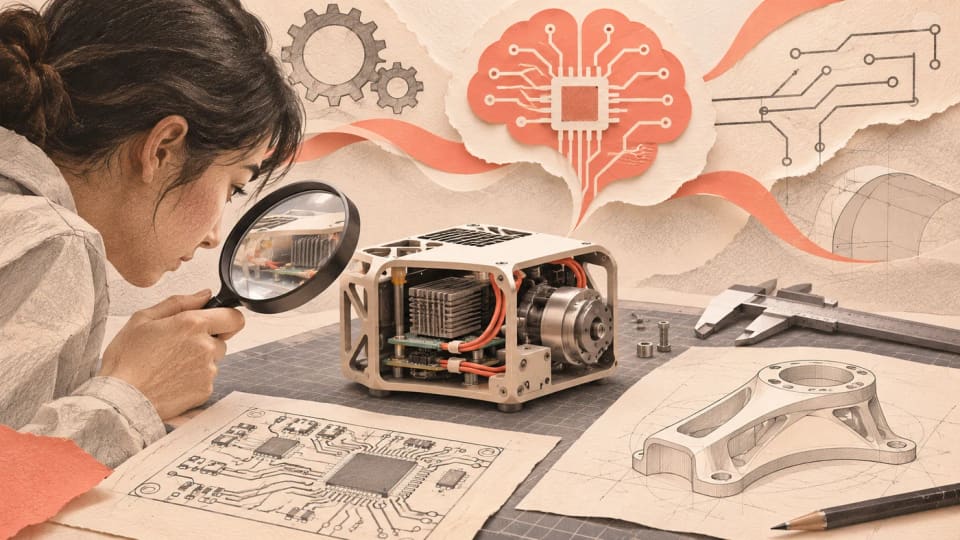
OpenAI has shared examples of AI-assisted engineering for physical products. Its November 3 report covers mechanical design, electronics, simulation and collaboration between disciplines. The examples describe internal work and industry experiments, rather than a finished consumer hardware launch.
What the prototype exercise involved
Two team members used Astra to develop a small device as a side project. OpenAI says the work included an enclosure, a printed circuit board and software integration, with a contract manufacturer later building a small prototype batch.
The useful detail is the handoff between digital design and a physical object. A plausible drawing or generated board layout is only part of that process; a manufacturer must still be able to assemble what the design specifies.
Where the report documents limits
OpenAI says preparing the device for manufacturing required multiple rounds of review and iteration. Astra did not consistently account for production constraints, tolerances and assembly details. Those are material limits for anyone interpreting the demonstration as a fully autonomous engineering workflow.
The publication also reports progress on an internal engineering benchmark and describes work with industry collaborators. Those observations have different scopes: a benchmark measures defined tasks, while an engineering team must validate a complete design in its operating environment.
What engineers can evaluate
The report describes partners reviewing generated models and drawings for accuracy and manufacturability. That suggests a bounded starting point: choose a design task with a clear reference, document constraints and identify the checks needed before an output enters production.
Measure the time spent reviewing and correcting the result as well as the time saved creating it. This is an editorial evaluation approach, not a new Franklin test. The announcement provides reasons to investigate AI assistance across CAD, electronics and simulation while preserving the engineering review that the reported prototype itself still needed.