
A laboratory model that tracks physical state
Google Research has described three projects connecting AI agents with laboratory robotics and experimental feedback. The work addresses a practical gap: a model can propose valid-looking code or a promising molecular design without accounting for what is physically possible or what an experiment actually measures.
The VERID framework maintains a live digital twin of a laboratory workcell. Google says it tracks geometry, liquid volumes, reagent identities and available equipment so proposed actions can be checked against the current state. The framework builds on PyLabRobot and combines simulation with synchronized video and execution records.
Feedback can expose the wrong objective
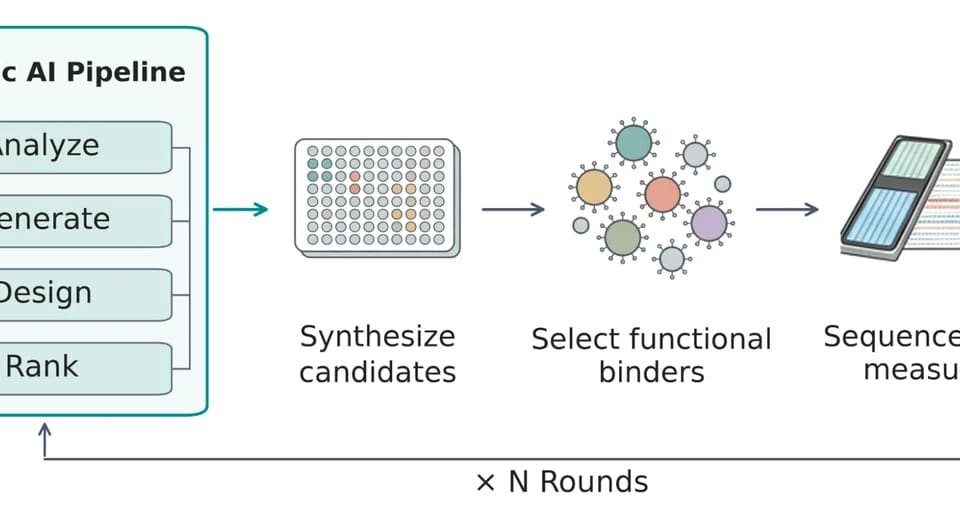
Google also describes closed-loop research prototypes for aptamer and protein-binder design. A useful finding in its account is that an apparently better raw binding result can conceal a measurement artifact. In one campaign, increased nonspecific binding initially looked promising until the experimental readout exposed the problem.
The agents then revised their design criteria in response to those measurements. That illustrates why a generated candidate and a validated result are different stages of scientific work. The report describes prototype experiments and measured binding behavior; it does not establish a treatment benefit for patients.
Human oversight remains part of the loop
Google states that humans authorize and review designed sequences, verify protocols and supervise robot runs. It also describes simulation before hardware execution and screening within selected, controlled testbeds. These are parts of the reported research workflow, rather than proof that autonomous laboratories have solved their reliability problems.
Franklin's reading is that the most useful contribution is the record connecting a proposal, its physical checks and its measured outcome. For researchers evaluating such systems, examine whether the logs can explain a failed run and whether the objective rewards the intended result. Google identifies integration of these separate research threads as a next step, so they should not be presented as a finished general-purpose autonomous lab.