
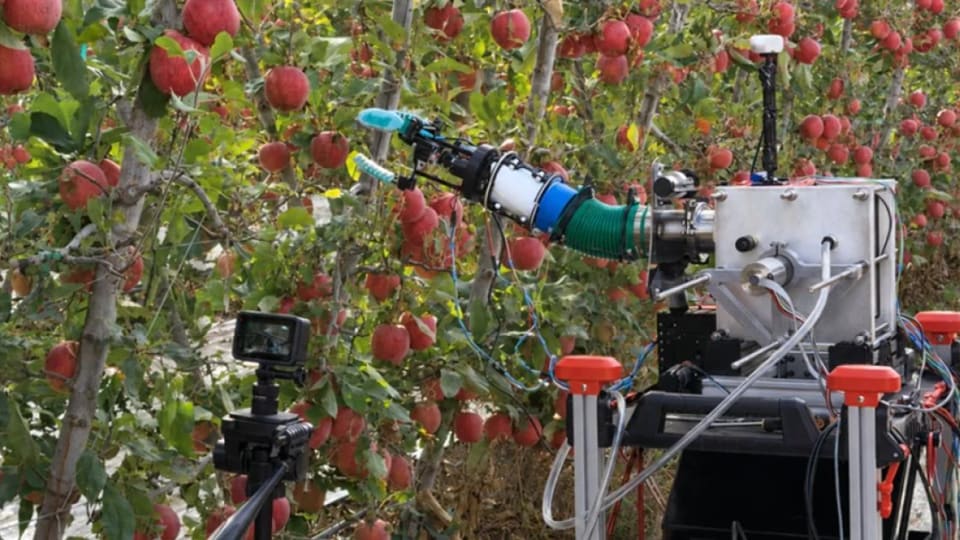
Robots and AI tools still need people who understand the orchard in which they operate, according to a study described by Michigan Farm News. UC Davis researchers studied 16 fruit-tree operations in California and Washington over three years, drawing on 165 interviews with growers and workers.
The work after a machine arrives
The study examines the practical integration of automation into changing farm conditions. Researchers describe this as the last mile: people have to adapt equipment to a particular crop, field and production system after it arrives.
Lead author M. Anne Visser argues that replacing a task does not automatically replace a job. Workers may instead interpret sensor output, troubleshoot equipment and coordinate the steps around a machine. The finding concerns the operations studied and should not be turned into a prediction that every agricultural job will remain unchanged.
A camera count needed interpretation
One example involved cameras counting buds and fruit to forecast yield. The report says this technology tended to overestimate production and needed interpretation using the field’s history.
A manager with more than a decade of experience adjusted a camera estimate downward by 14%, drawing on past block performance and recent weather. His estimate proved more accurate in that example. It illustrates the contribution of local knowledge; it is not a general instruction to reduce automated counts by the same percentage elsewhere.
Training matters alongside equipment
The researchers also describe the difficulty of automating fresh-market specialty crops, where quality matters alongside volume and growers cannot replace an orchard within a season. The report discusses possible improvements in efficiency, worker health and labour-shortage planning as people move into different roles.
For growers evaluating a tool, the study suggests documenting who checks its output and how field conditions change its usefulness. Equipment specifications alone will not describe the full work needed to integrate it.