
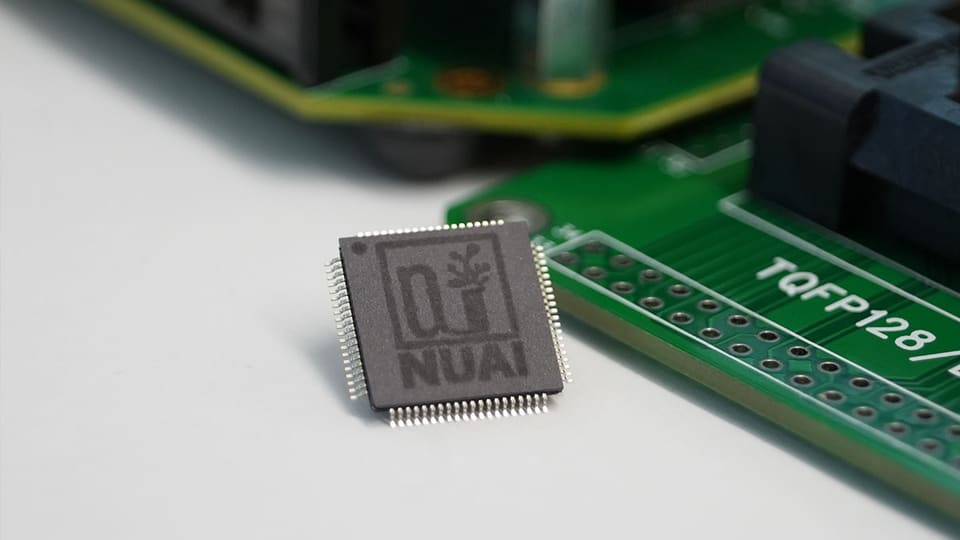
Researchers at the University of Texas at San Antonio have developed Genesis, a spiking neuromorphic accelerator designed to keep learning on a device without erasing earlier knowledge. The university's MATRIX AI Consortium is targeting catastrophic forgetting, the problem of losing a learned capability while adapting to a new task.
The chip is still in testing. In UT San Antonio's account of Genesis, the team also projects substantial energy savings. Those claims describe a research direction and hardware under development; the announcement does not establish that Genesis replaces general-purpose AI hardware across workloads.
Protecting useful connections while learning
Dhireesha Kudithipudi leads the team and is founding director of the MATRIX AI Consortium and the Neuromorphic Artificial Intelligence Laboratory. The university describes an architecture built around metaplasticity: regulating how readily a connection changes as the system learns.
Each processing element tracks its history as well as its current use, including its contribution and how often it has fired. Connections that the system treats as important resist overwriting, while new learning goes toward connections that remain flexible. That approach makes the preservation of earlier learning part of the chip's design.
The university illustrates the problem with a drone that first learns to detect wildfire smoke and then learns to recognize floods. Losing the smoke-detection skill during the second task would make the new learning less useful. That example explains the intended capability; it is not a report of a deployed Genesis drone completing those missions.
For a continual-learning system, retaining the first skill is as important as succeeding on the newest task. A useful evaluation would test performance across a sequence of tasks and examine what remains after each update. Readers should distinguish that question from a demonstration that a chip can learn one task in isolation.
Spikes and data movement shape the power claim
Genesis uses spiking neural networks, which process information through pulses. The university says the system rests when it has no tasks to complete. The team also designed a data-movement strategy that stores and accesses the information needed for learning in one place, addressing the power cost of moving data between memory and processors.
UT San Antonio says the testing-stage chip could consume 30 to 100 times less energy than traditional hardware. The announcement does not provide a complete comparison protocol or a named baseline for applying that range to every AI workload. The figure should remain attributed to the university and read as a qualified claim, rather than a universal efficiency result.
The chip's intended milliwatt operation points toward devices with limited power and unreliable access to cloud computing. The university lists wearable sensors, field-deployed drones and implantable medical devices among potential uses. That does not establish clinical approval, commercial availability or years of battery life in a finished product. Those would require separate evidence about the device and its operating conditions.
Hardware built through several prototypes
The current architecture follows two earlier prototypes developed over five years. The university credits doctoral students and postdoctoral researchers Vedant Karia, Fatima Tuz Zohora, Abdullah M. Zyarah and Nicholas Soures alongside Kudithipudi. The team developed learning algorithms and MetaplasticNet, a brain-inspired neural-network architecture, alongside the hardware.
According to the announcement, a partnership with SUNY Albany fabricates the chips using IBM's 65nm technology. A multimillion-dollar, five-year Air Force Research Laboratory grant supports the research effort. These details describe the development program, without establishing a production launch or customer deployment.
The team's next work includes scaling the learning mechanisms and preparing them for real-world deployment with other hardware and software. For readers following edge AI, that makes Genesis worth tracking through more detailed results: which tasks it can learn in sequence, how well it retains them, and how measured energy use changes with the workload. Those results would help connect the university's design claims to a device someone can use.