
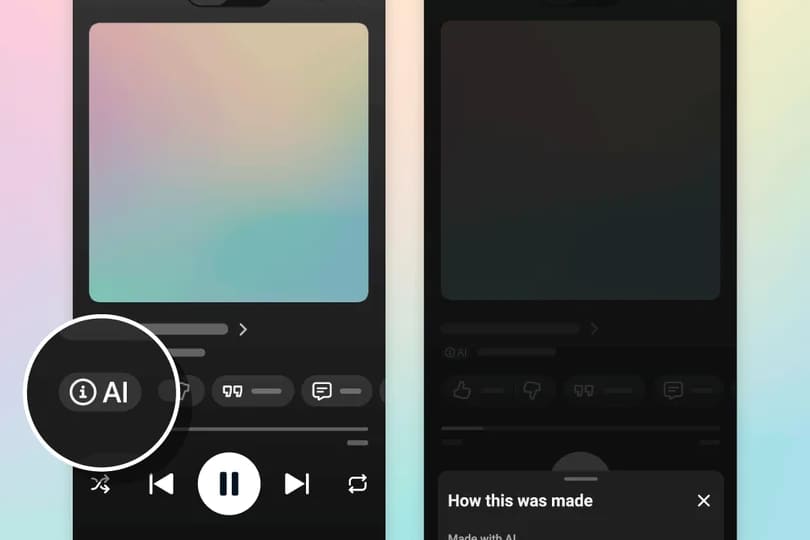
A disclosure appears beside the music
YouTube Music's announcement introduces player labels for songs created primarily using generative AI. The company gives composition and vocals generated with a model as an example of the kind of production covered.
The rollout began with the October 14 announcement. YouTube says the labels will also expand to its main app. When a track receives a label in YouTube Music, listeners can tap it to open a menu with more information.
Identification combines partners and detection tools
YouTube says it is working with music partners and using its own detection tools to identify AI-generated tracks. It frames the change as an extension of the labeling principles already used across YouTube.
The announcement is short. It does not provide a measured detection accuracy, a full list of supported production tools or evidence that every AI-generated song will receive a label immediately. It also does not say that using any AI-assisted editing step automatically makes a track primarily AI-generated.
For listeners, the visible change is additional information in the player. A production label describes how content was made; it does not by itself establish musical quality, the identity of every contributor or the terms under which the track may be reused.
Check the actual disclosure on a release
Franklin analysis: creators should review the current disclosure guidance against the way a specific track was produced. Keep a record of which elements used generative models so a distributor or platform can receive a consistent explanation.
Listeners who want production transparency should inspect the label and its information menu rather than infer provenance solely from how polished or unusual a song sounds. The rollout gives them another signal, with the limits of identification still worth keeping in view. An absent label during deployment should not be treated as proof that no generative AI was involved.