
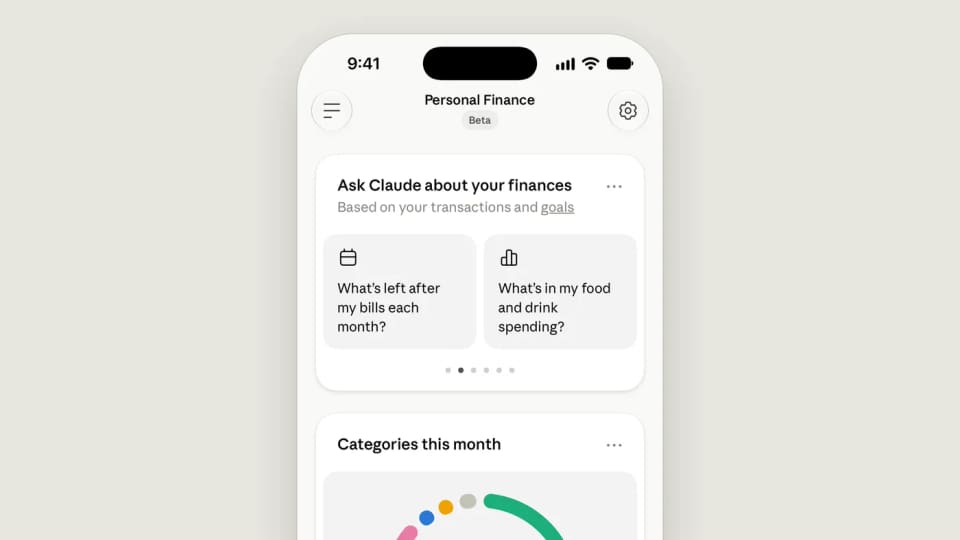
What Personal Finance in Claude does
Anthropic is rolling out Personal Finance in Claude in beta for US subscribers on its Pro, Max and Ultra plans. The official announcement describes a conversational view of balances, transactions and upcoming spending across accounts a user chooses to connect.
Access is read-only. Claude cannot move, manage or invest money through this feature. Its role is to explain account information and help users explore questions, such as where spending changed or which payments are due before payday.
How accounts and privacy work
Account connection happens through Plaid, where users sign in to their bank and approve access. Anthropic says Claude does not receive the bank password. For selected accounts, it can access account names and types, partial account identifiers, balances, credit limits and up to two years of transactions.
Conversations inside the Personal Finance hub are excluded from model training, according to Anthropic. Information shared elsewhere in Claude follows the user’s other privacy settings. That distinction makes the location of the conversation relevant; a promise about one hub should not be assumed to cover every interaction.
A useful first task and its limits
An initial question could ask Claude to explain a spending category and identify the transactions behind its total. That creates a result a user can compare with bank records before relying on a larger budget summary.
Anthropic explicitly warns that answers can contain mistakes and says the feature is not designed to provide investment advice. Franklin’s analysis is that transaction-level traceability is the important interface detail: a polished chart is more useful when its numbers can be checked. Read-only access restricts actions, but it does not make every explanation correct.