
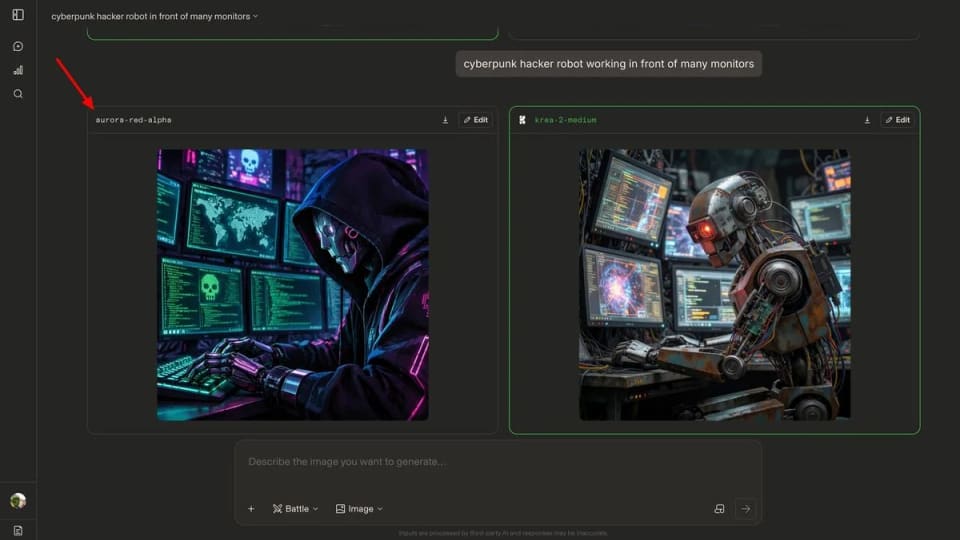
TestingCatalog reports that three Aurora model names briefly appeared in OpenAI’s API and subsequently appeared in image-generation arena tests. The report is an early observation of possible testing, rather than an official product announcement.
What the report actually observed
The names are aurora-red-alpha, aurora-green-alpha and aurora-blue-alpha. According to TestingCatalog, the API references were removed shortly after appearing. The story also includes images attributed to arena testing and discusses samples shared by other observers.
Its suggestion that Aurora could be GPT Image 3 is explicitly speculative. A temporary identifier and a handful of generated pictures cannot establish the eventual product name, release date or production availability. The supplied Arena screenshot illustrates the reported comparison; it does not independently prove who operates the model.
What is still missing
TestingCatalog says there is no documentation or pricing for the Aurora models. Its observations about speed and image quality come from limited samples. They should not be treated as a controlled benchmark or a reliable ranking across illustration, product photography, text rendering and editing tasks.
The report also mentions other arena codenames, but says there is no direct connection between those entries and Aurora. Combining separate sightings into a single launch prediction would go beyond the available evidence.
What image-tool users should do
Franklin’s practical interpretation is to keep these names on a watchlist rather than build a workflow around them. A useful release check would include official model documentation, supported editing inputs, output terms, actual pricing and access requirements. Until those exist, a team cannot reliably estimate integration work or operating costs.
Anyone comparing image tools today can still define a repeatable set of their own tasks and save the prompts and evaluation criteria. That makes a later comparison more useful if an announced model becomes available, without assuming these test identifiers will survive.
Read TestingCatalog’s original report for its screenshots and qualifications.