
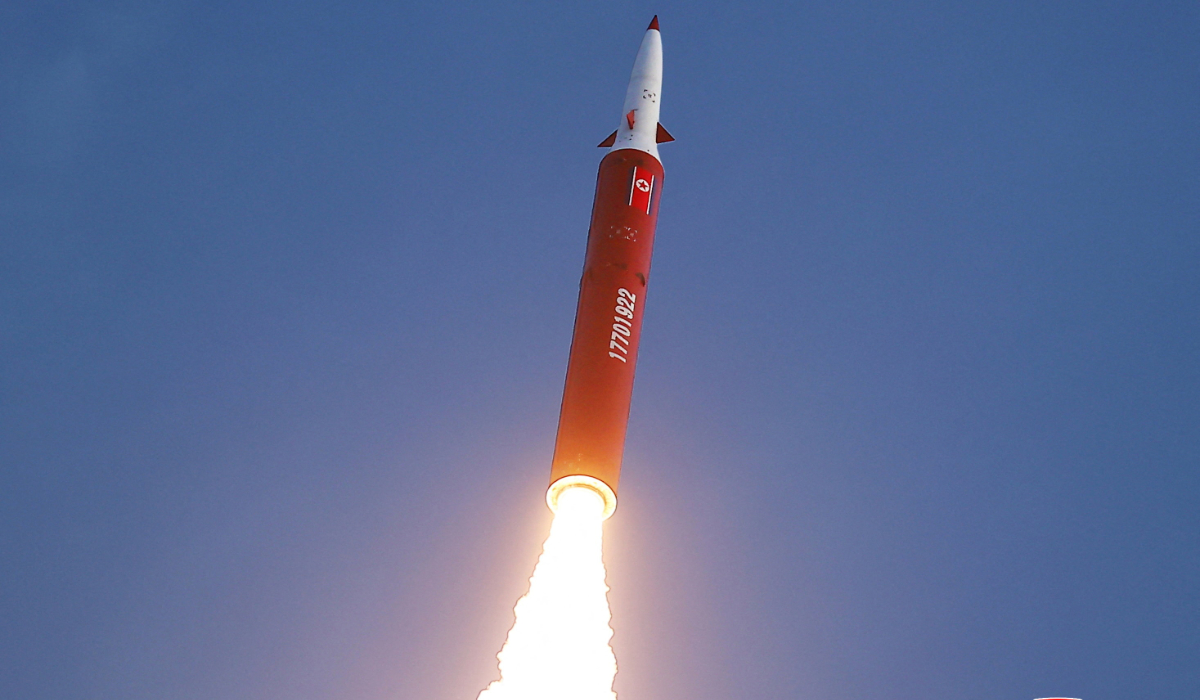
North Korean leader Kim Jong Un oversaw a missile launch that North Korean officials said used artificial intelligence to alter its trajectory, according to an AFP report published by Arab News on October 4. The report distinguishes the claimed technology from the flight details supplied by South Korea's military.
South Korea's military said the missile launched near the eastern coastal city of Wonsan early Saturday and flew more than 700 kilometers. It did not provide further details in the report. That account establishes a reported launch and distance, while the assertion about AI comes from North Korean statements.
The AI claim comes from Pyongyang
The AFP report carried by Arab News says Kim's sister described technology that could change the missile's flight path at low altitude. She also asserted that there was no way to avoid an attack. Both statements should be read as claims from North Korea, rather than an independent assessment of guidance performance or interception.
The available reporting does not identify an AI model, explain the system's inputs or provide a technical evaluation. It also does not establish what role AI played during the reported flight. A distance measurement and a statement about trajectory changes answer different questions; neither is enough on its own to demonstrate the implementation behind a claimed AI capability.
That uncertainty matters for coverage of military technology. A government can describe a weapon as AI-enabled without publishing the evidence that would let an outside observer evaluate the claim. The appropriate headline keeps the attribution visible instead of turning an official assertion into a verified engineering result.
A launch framed as a training exercise
North Korea's official Korean Central News Agency described the launch as training for soldiers operating a hypersonic strategic weapon system. In comments reported by AFP, Kim praised the soldiers' qualifications and counterattack posture, and called for continued efforts to demonstrate the country's strategic offensive capability.
KCNA released photographs of the missile ascending and of Kim with members of his family. The AFP report says his daughter Ju Ae and his wife Ri Sol Ju appeared with him. Arab News carries a photograph captioned as an intermediate-range missile firing during a drill overseen by Kim on October 3.
Photographs can illustrate that reported event, but they cannot establish the software behind the guidance claim. Readers should keep the visible launch separate from the technical interpretation that North Korean officials attached to it. We have not independently tested or verified the weapon's performance.
Regional tensions and the limits of the report
The launch followed South Korean demands for an apology over an explosion in the Demilitarized Zone that wounded three South Korean soldiers. Seoul blamed the North, while Pyongyang denied responsibility, according to AFP. The report also describes South Korean civilian leaders seeking a return to dialogue.
Those disputes supply the immediate diplomatic context for the launch. They do not resolve the AI question, and the report does not provide an independent technical account that would do so. Claims about trajectory control, vulnerability to interception or strategic advantage would require evidence beyond the officials' descriptions cited here.
For AI coverage, the useful development is that North Korean officials are presenting AI as part of their explanation of a missile capability. The next meaningful evidence would be a technical account that identifies how the claimed system operates and an assessment separate from the party promoting it. Until then, the reported launch, South Korea's flight-distance account and Pyongyang's AI assertion should remain distinct in the reader's understanding.