
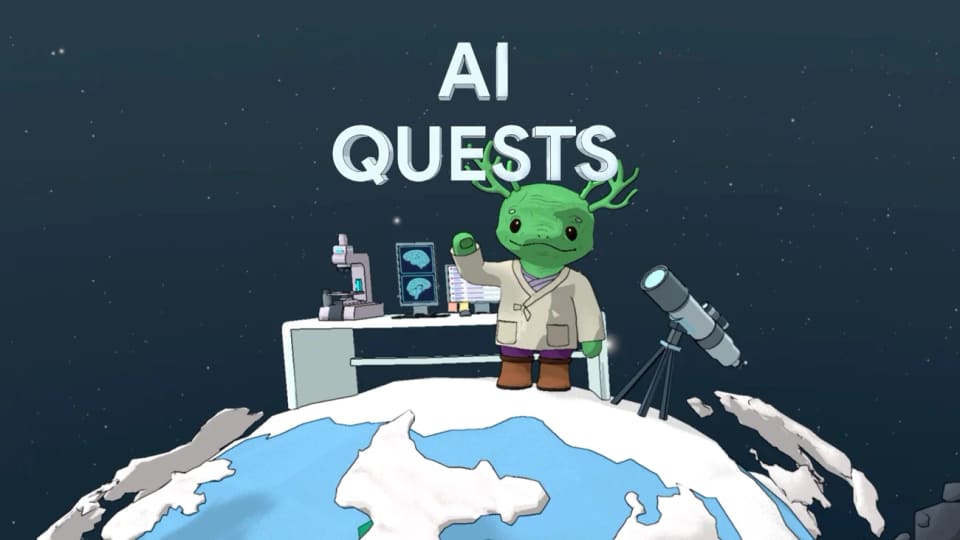
Google Research and the Stanford Accelerator for Learning have launched Polar Peaks, the third lesson in their AI Quests series. In Google’s announcement, students ages 11 to 14 use a brain-mapping story to explore how AI works and why people need to check its results.
Data work inside a game
Students follow in-game mentors, scan and map neurons and investigate a character’s memory loss. Activities include data cleaning and model testing. Google presents these steps as a way to teach oversight and critical thinking through a concrete task.
The lesson draws inspiration from Google’s connectomics research, which studies neural connections. After completing the quest, students hear from researchers involved in real brain-mapping work. The game is an educational activity; completing it is not the same as conducting a new neuroscience study or acquiring clinical knowledge about memory loss.
A third setting for AI literacy
The first two quests cover flood forecasting and eye-disease detection. Polar Peaks adds neuroscience as another setting in which students can discuss what information a model needs and how people judge its output.
Google reports more than 400,000 completed quests across the programme and localisation into ten languages. These figures describe participation in the series, rather than proof that a particular class has mastered the learning objectives.
Teacher materials have their own timetable
The announcement also introduces teacher training in the Google AI Educator Series. Modules for the first two quests are available, while the third quest’s training module is planned for the following month.
A teacher can use the new lesson to start discussion about cleaning data, testing a model and deciding when a result needs a person’s attention. Planning that discussion alongside the activity will help make the learning objective explicit. Check the current teaching materials before relying on a module that was still forthcoming at announcement time.