
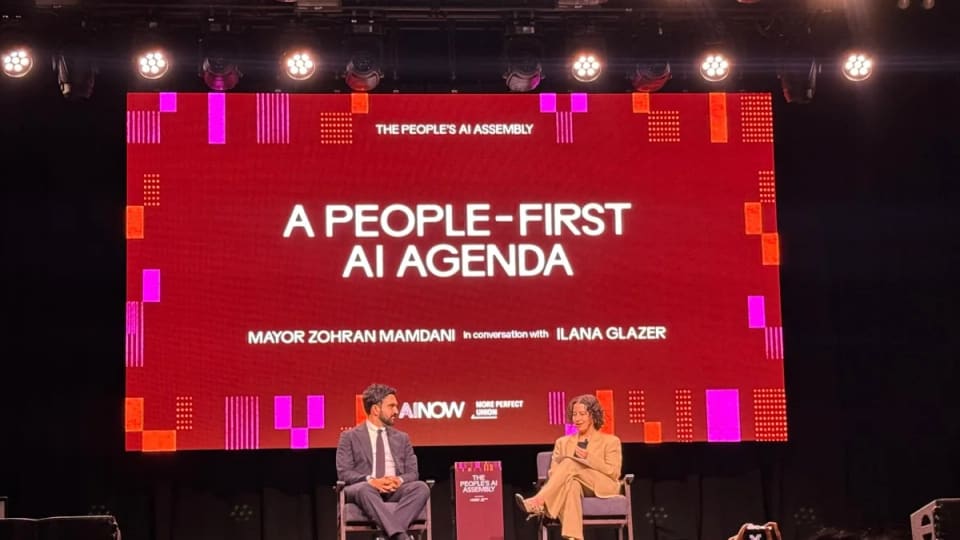
New York Mayor Zohran Mamdani argued that the public should have more influence over how AI enters daily life, according to TechCrunch’s October 19 report. He spoke with activist and performer Ilana Glazer at Webster Hall in Manhattan.
What AI accountability did Mamdani argue for?
The conversation took place at The People’s AI Assembly, hosted by the AI Now Institute. TechCrunch reports that Mamdani challenged the idea that AI’s rapid adoption is inevitable and urged public officials to hold companies accountable.
His criticism of federal policy was a political argument made at the event. It should be reported as his position, rather than treated as a neutral finding that every federal protection has disappeared or that a replacement framework has already been enacted.
Which concerns came up at the public forum?
The discussion connected AI to education, work and misleading content. Glazer raised concerns about the technology’s arrival in classrooms, while Mamdani argued against treating it as beyond question.
The article also discusses earlier local initiatives. Those references provide context for the speech, but this event summary is not a guide to the current legal obligations of schools, property businesses or technology providers. A proposed rule, an existing policy and an argument for future regulation are different things.
What should follow the speech as a concrete proposal?
Franklin’s interpretation is that the useful next step is to move from broad positions to concrete decisions. For any proposal, ask which use of AI it covers, who would enforce it, what evidence would trigger action and what recourse affected people would have.
That approach works whether someone favours rapid adoption or stronger restrictions. It makes a public promise assessable without assuming that an AI label alone determines a technology’s benefit or risk.
