
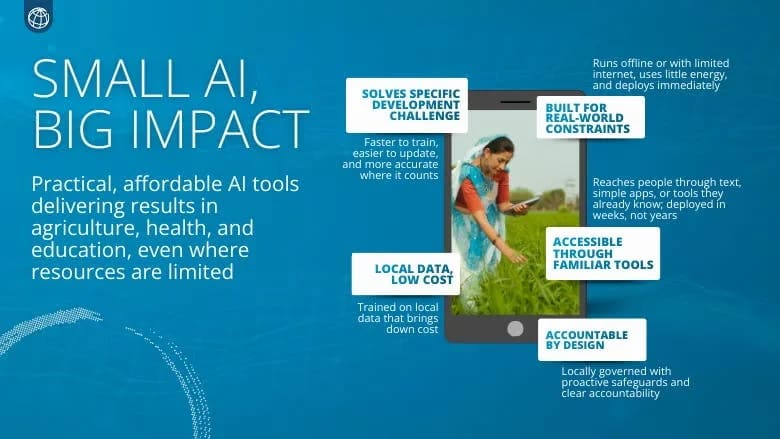
The World Bank's Small AI brief, published on April 2, 2026, describes practical AI systems built around local development problems and operating constraints. It is useful background for understanding the institution's approach, rather than evidence of a newly announced, fixed-size funding programme.
Start with the operating environment
The brief describes affordable solutions that can run on everyday devices. It emphasises settings where connectivity, available skills and computing resources may be limited. That changes the design question from how large a model can be to whether a system can deliver a useful result in the place it will be used.
The World Bank gives examples in agriculture, health and education. These illustrate the intended range of applications; they should not be treated as a guarantee that every product using the Small AI label has demonstrated equivalent results.
Local fit is part of the system
The approach includes reducing policy barriers, helping the private sector pilot and scale applications, and strengthening the foundations for responsible adoption. Its accompanying infographic emphasises local data, familiar tools, real-world constraints and accountability.
Those considerations make deployment more than a model-selection exercise. A technically capable system can still be a poor fit if its users cannot access it reliably, understand its output or obtain help when something goes wrong.
How to evaluate a proposed project
Choose a specific task and define what a useful outcome would look like for its intended users. Then examine device requirements, connectivity, language, data suitability and who is responsible for ongoing operation.
This is an editorial evaluation approach drawn from the brief's emphasis on local constraints. It does not establish a particular grant amount, a guaranteed number of participating countries or a projected increase in national output. The value of the document is its practical design framework, with actual project evidence needed to assess an individual implementation.