
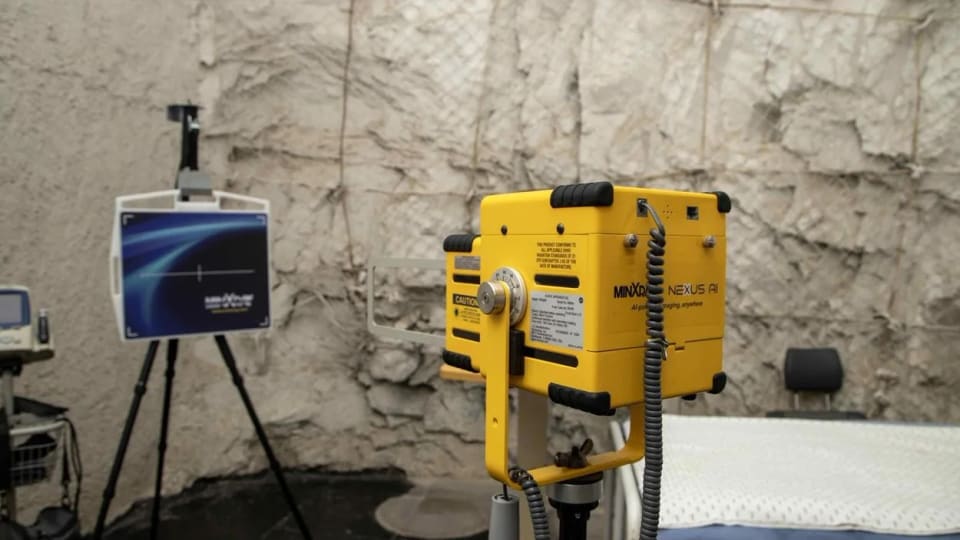
Google Research has described how portable imaging and locally running models can support tuberculosis screening in settings with limited access to radiologists. Its TB-screening account covers partner deployments and developer foundations, with clinical decisions remaining the responsibility of healthcare professionals.
Bringing screening closer to patients
Google reports that Nexus AI’s tool operates in approximately 40 healthcare facilities across six African countries. It describes portable X-ray equipment and offline AI being used four kilometres underground at South Africa’s Mponeng Gold Mine. People flagged with presumptive TB can then be referred for confirmatory molecular testing.
That workflow distinction is important. A screening flag is a reason to investigate further; it should not be presented as a confirmed diagnosis. The practical question for a health programme is whether a flagged patient can actually reach the next step in care.
Local models and local adaptation
The account connects the deployments to Google’s Health AI Developer Foundations, including chest X-ray embeddings, MedSigLIP and MedGemma. Google describes Indonesia’s Ministry of Health fine-tuning models on domestic chest radiographs and using local infrastructure to keep patient data within national borders.
For an evaluating institution, model availability is only one part of the work. The data used for adaptation, the intended clinical setting, local oversight and the process for handling uncertain cases all need their own assessment. The article does not establish that an open model is ready for every clinic without that work.
Separate field reports from universal results
Google reports that clinicians retain final clinical decisions. It also describes research on cough-based acoustic screening through HeAR, alongside imaging-based approaches. Those methods have different inputs and validation requirements; they should not be treated as interchangeable tests.
The source is Google’s account of collaborations and reported deployments. Franklin has not independently reproduced their clinical outcomes. Readers considering implementation should examine the underlying evaluation, local regulatory requirements and confirmatory-testing pathway with qualified clinical teams.