
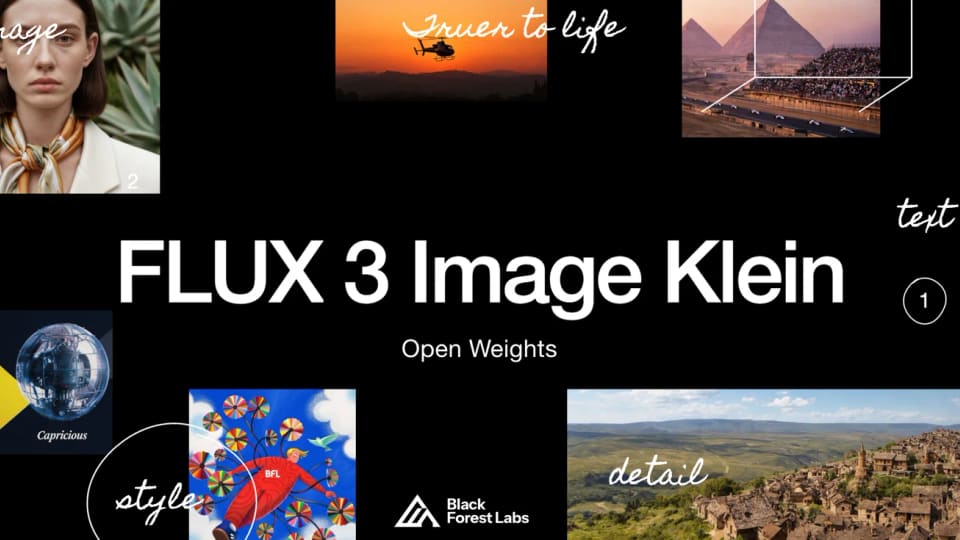
One model for generation and editing
Black Forest Labs has introduced FLUX 3 Image Klein, a 5.6-billion-parameter image model with downloadable weights. The company describes support for text-to-image generation, image editing and multi-reference generation using up to 10 reference images.
That combination puts several related tasks in one model family. A user can start with a written description, revise an existing image or provide multiple visual references. The announcement also describes native 4K output and bounding-box controls, although those capabilities still need to be evaluated on the particular task and implementation a user plans to run.
Choose the variant and hardware together
The release includes a base model intended for fine-tuning and a step-distilled variant intended for lower-latency generation. Black Forest Labs also lists reduced-precision formats, including FP8, INT8 and NVFP4. These are deployment choices with different resource requirements, rather than interchangeable labels for one universal hardware setup.
The company says its INT8 build can run on NVIDIA GeForce GPUs with as little as 8 GB of VRAM using supported ComfyUI or Diffusers workflows. That is a publisher claim about a particular build and workflow. It should not be generalized into a promise that every resolution, reference count or configuration fits the same memory budget.
Read benchmarks and availability precisely
Black Forest Labs reports strong results on its own evaluations. Those figures describe the company's testing; this article does not independently reproduce them. The weights are offered under the named FLUX Kommunity License, so downloadable weights should not be described as an unrestricted licence grant.
Franklin's reading is to begin with a representative edit or reference-image task, then measure quality, memory use and generation time on the intended setup. Choose between the base and distilled variants according to whether adaptation or response time matters more. The announcement supplies concrete options to test, rather than evidence that one configuration is best for every image workflow.