
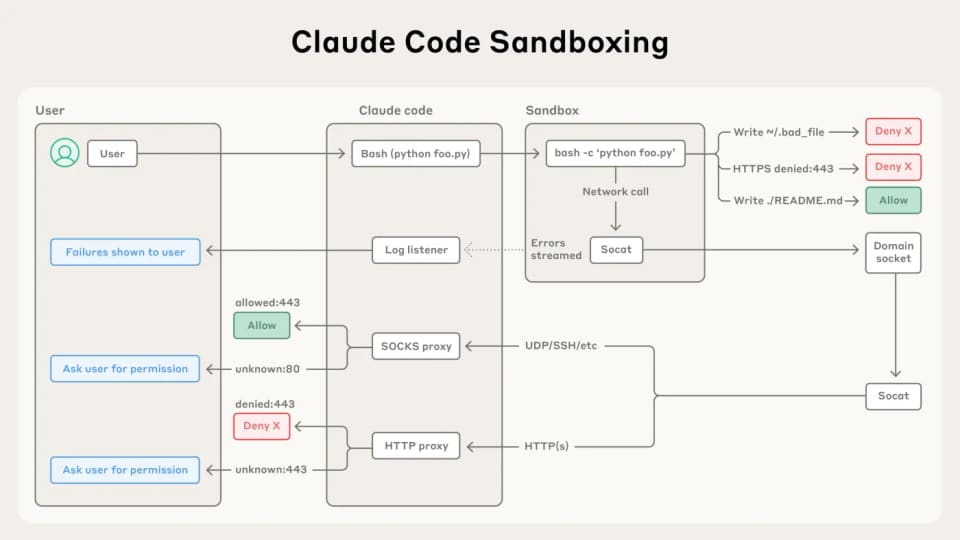
Anthropic's October 2025 sandboxing introduction describes a way to give coding agents room to work inside defined limits. This is a background explanation of that earlier announcement, rather than a claim that the runtime was newly launched in October 2026.
Why permission prompts are only one layer
The publication describes the friction created when users must approve many individual operations. Anthropic reports that its internal use of sandboxing reduced permission prompts by 84%. That is a company-reported usage result, not a new Franklin test or proof that every unsafe action was prevented.
The underlying idea is to define an operating boundary in advance. Within that scope, an agent can perform permitted work with fewer interruptions, while the boundary limits what it can reach outside the task.
Two boundaries need to work together
Anthropic describes filesystem isolation and network isolation. Filesystem controls restrict which directories an agent can access or modify. Network controls restrict the servers it can contact.
The article explains why having only one of those protections leaves important gaps. A system that limits files but allows unrestricted network activity has a different exposure from a system that limits outbound connections while permitting broad filesystem changes.
How to evaluate the approach
For a concrete workflow, identify the files and network destinations it actually needs. Then check how the selected tool and environment enforce those limits. Review the current product documentation before assuming the historical announcement describes every available platform or setting today.
The useful assessment is whether the real execution environment matches the intended scope, including what happens when an operation falls outside it. Treat the sandbox as a layer alongside appropriate permissions, review and monitoring. The original article motivates a more structured approach to agent autonomy; it does not establish an unconditional containment guarantee for every configuration.