
CanvasGPT
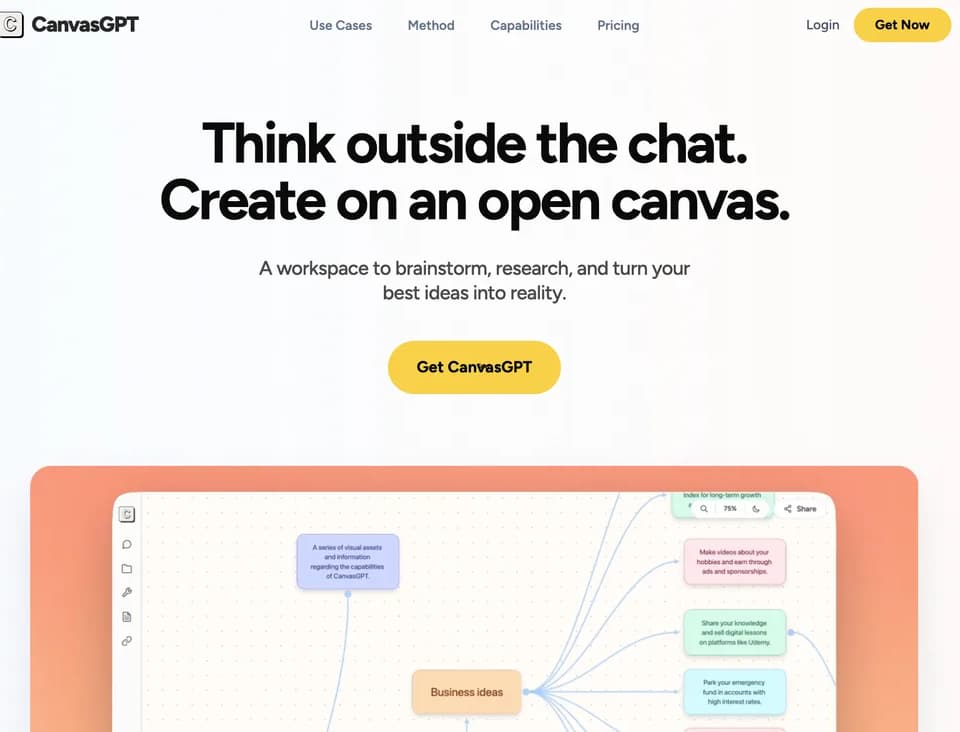
CanvasGPT is a visual workspace for researching ideas, creating assets, and building tools on an open canvas. Its official page describes a workflow that connects source material and generated outputs in one place. You can organize a research board, produce media from that context, and turn the result into an interactive artifact or website.
Bring research and files onto the canvas
CanvasGPT accepts media from the web, clipboard, or your computer. The publisher lists images, PDFs, and documents as inputs for its file-intelligence feature. You can interact through voice or text and arrange ideas using mind maps and visual boards.
Smart grouping organizes the workspace, while a focus view lets you zoom into an artifact. Connectors link artifacts into a knowledge graph. The page also names Google Search and Maps, Wolfram Alpha computation, and academic papers among the research resources it makes available.
Produce assets and working tools
CanvasGPT lists image and video generation alongside sprite sheets, sound effects, and music. Its live-editing feature starts with an uploaded image and creates new images from it. Documents, presentations, and visual concepts are also named among the outputs you can create.
The service describes specialized AI roles such as mind mapper, data analyst, and presentation designer. Dynamic artifacts can share data and connect automated inputs and tasks. This gives the canvas a role beyond keeping files together: the publisher presents it as a place to connect steps in a working project.
Publish and collaborate
CanvasGPT can publish what you build as a live website. It also provides a portal with logins and permissions to control what individual people see. The page says a team plan includes shared workspaces with real-time canvas collaboration, and you can share a canvas using a link.
Pay for usage with credits
CanvasGPT advertises pay-as-you-go credit packs. The displayed $25 pack is approximately 2,500 credits, valid for one year. Its task, image, and document-analysis counts are labeled estimates based on usage, so they describe estimated capacity rather than a fixed number of every possible operation.