
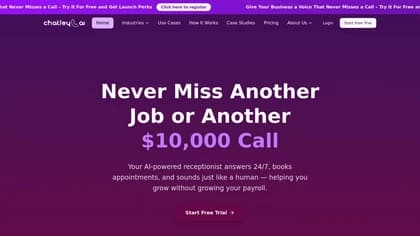
Chatley
Chatley is a customer communication platform for handling calls, chats, and messages with AI agents. The Chatley AI platform is designed to help businesses respond to customers, follow up with leads, and manage conversations across multiple channels.
What it does
Chatley provides AI agents for inbound and outbound voice calls, chat, and messaging. According to the vendor, agents can answer calls, detect caller intent, leave relevant voicemail messages when staff are unavailable, follow up with leads, book appointments, and record conversation activity in a CRM.
The platform includes no-code tools for creating agents from templates. Businesses can configure agent personalities, business rules, channel-specific behavior, and business knowledge. Teams can also test conversations across channels before deploying an agent.
Notable capabilities
- Voice, chat, and messaging agents for customer communication.
- Intent detection and automated voicemail messaging for unanswered calls.
- No-code workflow automation for CRM record creation, follow-ups, callback scheduling, and handoffs to human agents.
- Real-time reporting for call success rates, sentiment analysis, conversion metrics, and agent performance.
- Vendor-stated support for more than 150 concurrent calls, sub-second speech-to-speech latency, 24/7 availability, and PSTN telephony infrastructure.
Who it helps
Chatley is positioned for BPOs and call centers that need to handle tier-one support and overflow calls. Retail teams can use its agents for order tracking, frequently asked questions, and customer support. Financial services and insurance organizations are identified as use cases for caller verification, claims processing, and account requests.
It may also fit businesses that want to centralize lead response, appointment booking, and customer messaging without requiring every interaction to be handled manually.
How it fits a workflow
A team can upload business knowledge, configure an agent, run test conversations, and deploy the result across supported communication channels. Conversation outcomes can trigger follow-up actions, such as creating a CRM record, sending a message, scheduling a callback, or routing the interaction to a human representative. Reporting tools then provide visibility into outcomes and agent performance.
Chatley states that it is designed to connect with existing enterprise systems and workflows, but the supplied information does not identify a complete list of supported integrations. Teams evaluating the platform should verify that their CRM, telephony setup, compliance requirements, escalation rules, and channel mix are supported.
Strengths and limits
Chatley’s stated strengths are its multi-channel focus, no-code agent configuration, workflow automation, testing process, and support for high-volume voice operations. Its industry examples also indicate attention to structured customer-service workflows rather than only open-ended conversation.
The website does not provide pricing, detailed integration specifications, or independent performance testing. Organizations should therefore validate implementation requirements, data handling, human handoff behavior, and the vendor’s capacity and latency claims against their own call volumes before deployment.