
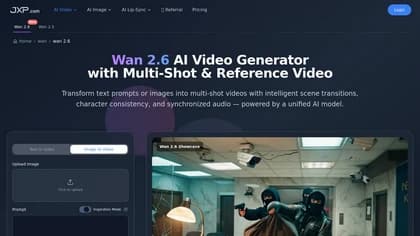
Wan 2.6
Wan 2.6 is a short-form AI video generator available through JXP. It creates video from text, images, or reference videos, with tools for multi-shot storytelling, character continuity, dialogue, and synchronized audio.
What it does
Wan 2.6 turns a described concept or visual reference into a video sequence. Users can choose text-to-video, image-to-video, or reference-to-video generation, then describe actions, dialogue, camera changes, and atmosphere in natural language or shot-based prompts. An intelligent split mode can schedule multiple shots from a prompt; JXP says this can maintain consistency across subjects, scenes, and overall atmosphere.
The generator supports output at 720p or 1080p, with selectable durations of 5, 10, or 15 seconds. JXP describes Wan 2.6 as producing native audio, including human voices, music, and sound effects, with audio-visual synchronization. The site also advertises multilingual support, stable multi-person conversations, and what it calls precise lip-sync for voiceovers and dialogue.
Notable capabilities
- Reference-guided generation: Use people, characters, objects, images, or reference videos to guide the result, with JXP claiming identity and voice consistency.
- Multi-shot storytelling: Automatically organize connected shots from natural-language or shot-level instructions.
- Native audio generation: Create voices, music, and sound effects together with the video, including synchronized dialogue.
- Separate audio input support: JXP says Wan 2.6 can accept audio such as music or sound effects as input.
- Flexible delivery: Generate 16:9, 9:16, or 1:1 video and export in MP4, MOV, or WebM, according to the site.
Who it helps
Wan 2.6 is aimed at creators making short narrative videos, social clips, explainers, product marketing, and educational content. Its reference and continuity features may suit projects that need recurring characters or objects, while multi-shot prompting is relevant to short films, trailers, and other structured sequences. Marketers can use it for branded concepts and product videos, and educators can use scripts or images as the starting point for narrated visual content.
How it fits a workflow
A typical workflow starts by selecting text, image, or reference-video input. The user then describes the scene or story, optionally enabling multi-shot generation, and reviews the resulting audio-visual clip. Prompts can be refined before exporting the video for publishing or further use. JXP also states that Wan 2.6 creations include commercial rights. Its pricing page describes JXP credit plans, while the exact credit cost for a generation depends on settings such as model, duration, resolution, and references.
Strengths and limits
Wan 2.6's advertised strengths are reference control, multi-shot sequencing, short-form 1080p output, and built-in audio. The practical limit is clip length: the advertised maximum is 15 seconds, so longer stories would need to be assembled from multiple generations. Results may also depend on prompt detail, reference material, and selected generation settings; the source does not provide independent quality benchmarks or hands-on evaluation.