
BitDive
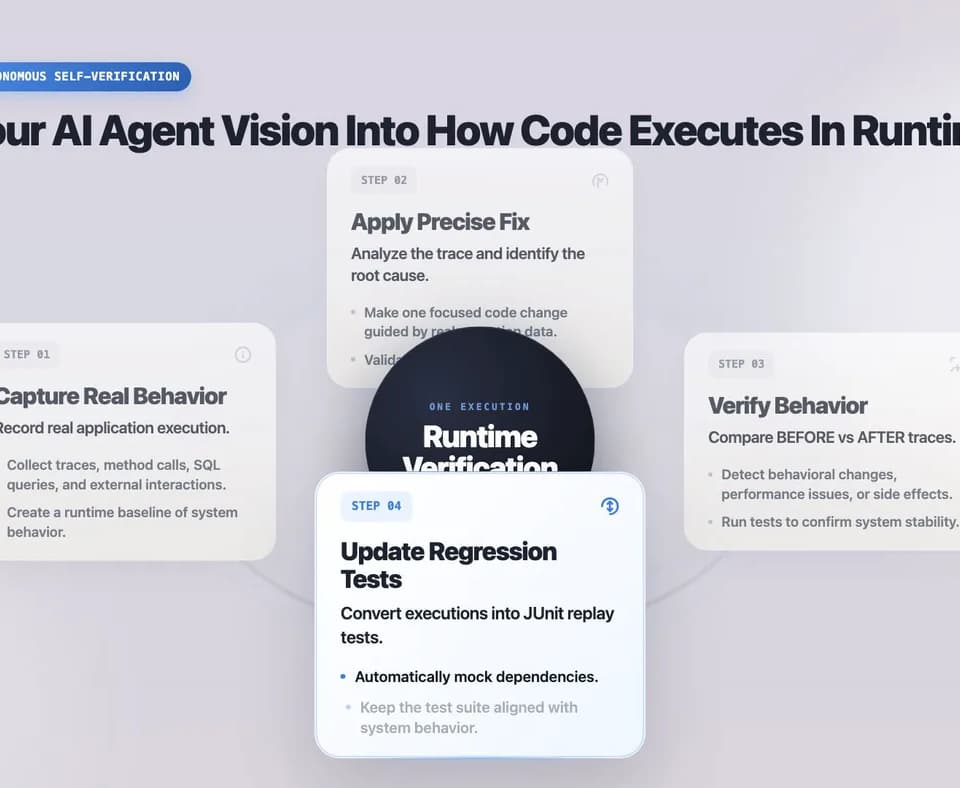
BitDive provides runtime capture and verification tools for Java applications, including AI-assisted development. Its official site describes a workflow in which a team records a real execution, makes a change, compares the new trace, and preserves the verified behaviour in a regression suite.
Capture the execution behind a problem
BitDive captures method arguments and return values, SQL queries, HTTP exchanges, Kafka interactions, timings, and exception paths. A developer can inspect the execution tree to identify the input, dependency call, or method involved in a failure. The publisher describes Java instrumentation and configurable masking before sensitive information leaves application memory.
This approach needs a recorded application execution. It gives a team evidence about the scenarios captured, so selecting representative requests and deciding what behaviour is intended remain part of the verification work. Performance and engineering-savings figures on the site are publisher claims, rather than measurements from an evaluation conducted here.
Replay-based tests and database options
The product introduction describes JSON replay plans run through a standard JUnit runner. External dependency responses can be replayed from captured traces, and the resulting tests fit the Maven workflow.
BitDive distinguishes method-level tests from integration tests that boot the Spring context. Replay mode uses captured dependency responses. Testcontainers mode runs scenarios with real databases while external APIs remain replayed. A team checking a database constraint or schema change should consider that distinction when choosing its test mode.
Agent access and baseline control
The MCP integration guide lets an agent inspect traces, obtain a reproduction command, compare executions, and refresh regression baselines. It requires a running BitDive instance and MCP configuration in the client.
New traces require a real request to a service with the BitDive agent attached. Replaying an existing JUnit test does not capture a new before-and-after trace. After a code change, the documented workflow triggers the same endpoint or business flow again and compares that execution with the baseline.
BitDive MCP provides runtime evidence through approved operations and does not expose a raw database shell. Baseline refresh should follow confirmation that the new behaviour is intended. The captured pages do not list subscription prices, so confirm deployment costs and the required technology coverage with the publisher.