
Uthana
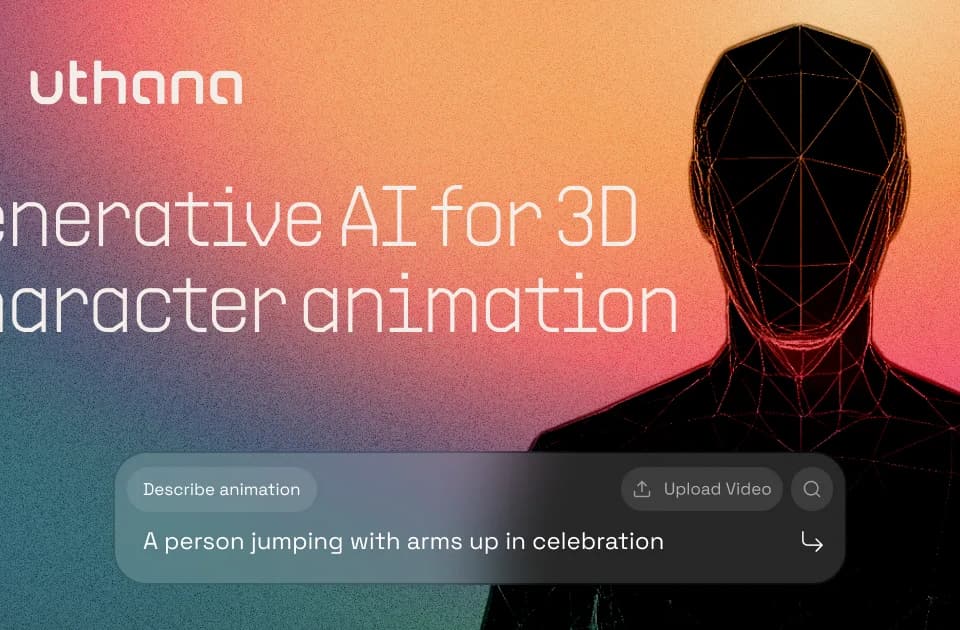
Uthana provides human-motion models and data for animation, simulations, and embodied AI. You can generate movement from text, extract structured 3D motion from 2D video, or produce locomotion from direction, speed, and trajectory. The Uthana platform overview also describes rigging and retargeting for moving that motion onto different bodies.
Generate movement for a character
Text-to-motion accepts descriptions of action, sequence, pacing, posture, and style. Video-to-motion converts footage into editable 3D movement. These capabilities suit an animator who needs a new movement or a development team building motion into a 3D experience. Uthana also positions its structured outputs for robot training and world-model datasets.
Motion retargeting transfers movement between character skeletons. Auto-rigging prepares an unrigged character for animation, while robot retargeting converts human movement into robot-specific joint representations. A team should distinguish these operations when planning its pipeline: creating motion, preparing the character, and mapping movement onto its body are separate tasks.
Web creation and API integration
The GraphQL API covers generation, video extraction, retargeting, and auto-rigging. The API quickstart documents Python and JavaScript/TypeScript clients and requires an account and API key. You can start with the default character or upload an FBX or glTF character through the web interface. Uthana attempts auto-rigging if the character has no skeleton.
The quickstart shows FBX and GLB downloads, including a motion-only GLB without the character mesh. Developers should follow the documentation for the model version they choose. The changelog says Text-to-Motion 3.0 uses an asynchronous job that must be polled to completion; a July 2026 update made that model available to pay-as-you-go accounts.
Unit pricing and commercial use
Uthana's pricing page uses one credit balance across the web app and API, with no required subscription. Rates are in US dollars: Text-to-Motion 3.0 costs $0.10 per generated second, Video-to-Motion 2.0 and 2.1 cost $0.05 per second, and auto-rigging costs $0.15 per rig. Other versions and operations have their own listed rates. Purchased credits do not expire, and paid usage includes commercial use subject to Uthana's Terms of Use.
Uthana stopped offering new subscriptions in August 2026; existing subscribers may retain their plans unless they switch. Generated motions have unlimited downloads. Dataset licensing and custom programs require scoped pricing because coverage, metadata, delivery, and integration needs differ. For a training project, discuss the exact skeleton conventions, units, and labels before agreeing on a dataset delivery.