
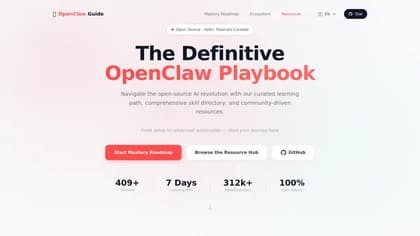
OpenClaw Guide
OpenClaw Guide is a public GitHub handbook written by Mykyta Haida for people setting up and operating OpenClaw. The guide repository gathers installation, configuration and ongoing operation into a fifteen-part reading path. It is an independently authored guide; the README says it draws on official documentation, community tutorials and the author's experience.
The reading path
The chapters begin with architecture and installation, then move to configuration, messaging channels and workspace memory. Later chapters cover tools, skills, scheduled automation, multiple agents, security, model providers and cost optimization. Nodes and devices, troubleshooting and additional resources complete the directory.
This organization lets a beginner work through setup in order while a current operator can go directly to a relevant topic. The installation chapter is described as covering VPS, Docker, WSL2, cloud platforms and Oracle Free Tier. The security chapter lists hardening and the ClawHavoc incident among its subjects. Those are documented topics, rather than a claim that following the guide guarantees a secure deployment.
What the architecture chapter explains
The introductory chapter describes a Gateway process that routes messages, assembles context and executes agent tool calls. It explains how workspace Markdown files define behavior and memory, while session history uses JSONL files.
The chapter also separates tools such as shell execution, browser interaction, file access and messaging, and says each tool can be enabled or disabled independently. This gives readers a way to understand which part of a configuration controls an agent's actions before enabling it on a machine.
Access and information limits
The repository makes the guide available under the MIT License. Readers can open an issue or submit a pull request to report an error or contribute material. The README includes a short VPS-and-Telegram setup walkthrough and example hosting and model-cost scenarios.
The introductory chapter dates its project statistics to February 2026. Provider prices, commands and platform support can change, so use the guide's examples to understand the setup and consult the corresponding current product documentation before purchasing hosting or running installation commands. The guide is a reading resource, with operational details that still need to match your chosen OpenClaw version and deployment.