
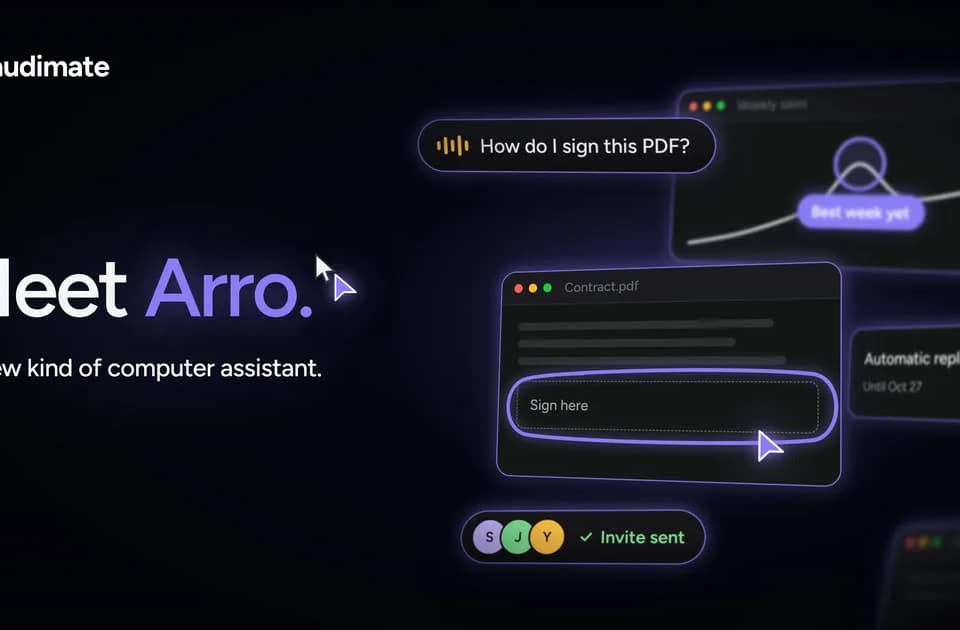
Arro: a cursor-aware assistant with editable task playbooks
Arro is Audimate’s computer assistant for asking about what is on screen, receiving step-by-step guidance and delegating repetitive work. The company presents a cursor-aware interaction: point at the relevant part of an application, hold a key and speak, instead of repeatedly describing the screen in a separate chat.
Guidance and delegation are separate modes
The Audimate website demonstrates Arro pointing through a PDF-signing workflow and waiting while the person completes the steps. Other examples show delegated work, such as finding a meeting time and preparing expenses.
That distinction is useful when evaluating an assistant with computer access. Some tasks benefit from an explanation while the user remains in control of each step. Others can be delegated only after the expected outcome and action boundaries are clear. The website’s examples show the intended interaction, rather than a Franklin test of every application shown.
Demonstrations become editable playbooks
Arro’s repeat-work model starts with showing it a task. The service says it records the procedure as a playbook the user can read and edit, then replays it on request or on a schedule. Its examples include following up on overdue invoices and onboarding a client.
Teams can share a playbook and refine the same document. The site also describes adapting when an application changes and noting the difference for an update. That is an advertised capability, not evidence that arbitrary interface changes can always be handled correctly.
Evaluate the procedure before scaling it
A practical trial would use a small, reversible task and inspect the written playbook before replaying it across a list. Check the inputs, completion condition and any step that sends a message or creates a commitment. Then compare the replay with the intended procedure.
Arro’s distinctive feature is the readable procedure between demonstration and repetition. That gives a team something concrete to inspect and improve, rather than relying only on an assistant’s claim that it understood the task.