
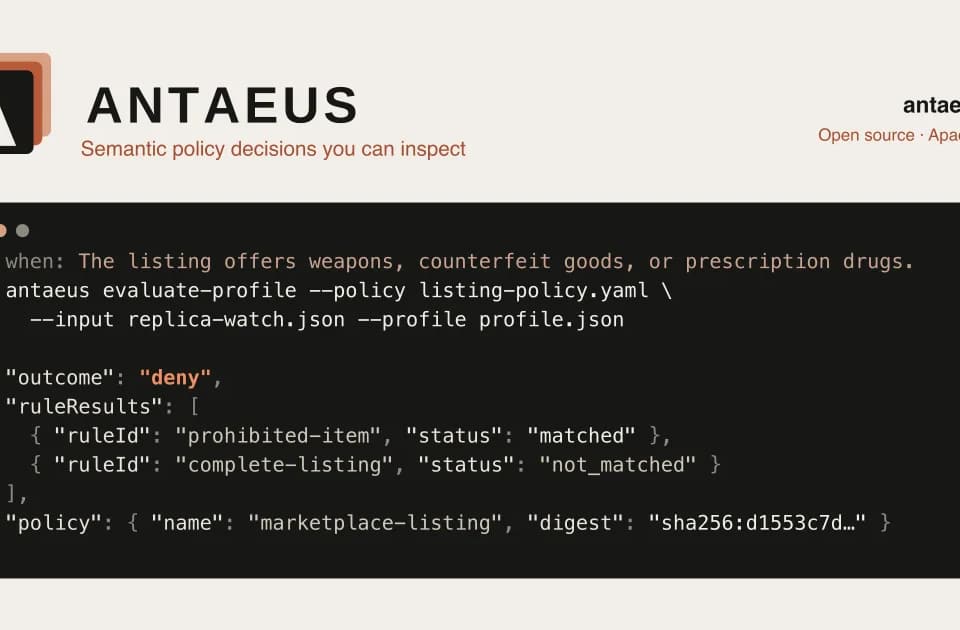
Antaeus: inspectable policy decisions with versioned rules and explicit outcomes
Give a policy decision a traceable identity
Antaeus is an early semantic-policy engine for developers who need to inspect how a language-based rule produced a decision. Its website describes versioned YAML or JSON artifacts, named test cases and evidence that an application can consume.
The intended boundary is a question that requires interpretation of meaning or context. Antaeus explicitly leaves authentication, authorization, transactions and side effects to the surrounding application. A policy decision is one input to that application's behavior, rather than a replacement for its authority model.
Four outcomes preserve different meanings
The decision contract separates allow, review, deny and failure. Review represents an accountable human decision point or the policy's declared review default. Failure means the evaluator could not produce sufficient evidence. Keeping those states separate lets an application choose what to do when evaluation is unavailable instead of silently interpreting an outage as a substantive policy judgment.
The public quickstart uses an exact synthetic fixture. It validates a policy artifact and checks routing and regression contracts without credentials or a network call. That demonstration establishes the local contract, not the accuracy of semantic model inference.
What is experimental today
The publisher describes an experimental bring-your-own-key OpenAI evaluator for real conditions. The hosted beta has shared capacity and no production SLA. Behavioral comparison is planned, and the website says no empirical result has yet been published for the separate research track.
Franklin's suggested evaluation is to begin with a bounded policy and a few named cases whose expected outcomes are explicit. Inspect the artifact identity and failure behavior first, then separately test the semantic evaluator on difficult cases. This makes the distinction between a working contract and a reliable interpretation visible. The open repository and local workflow support inspection, but they do not establish that every consequential policy is ready to delegate.