
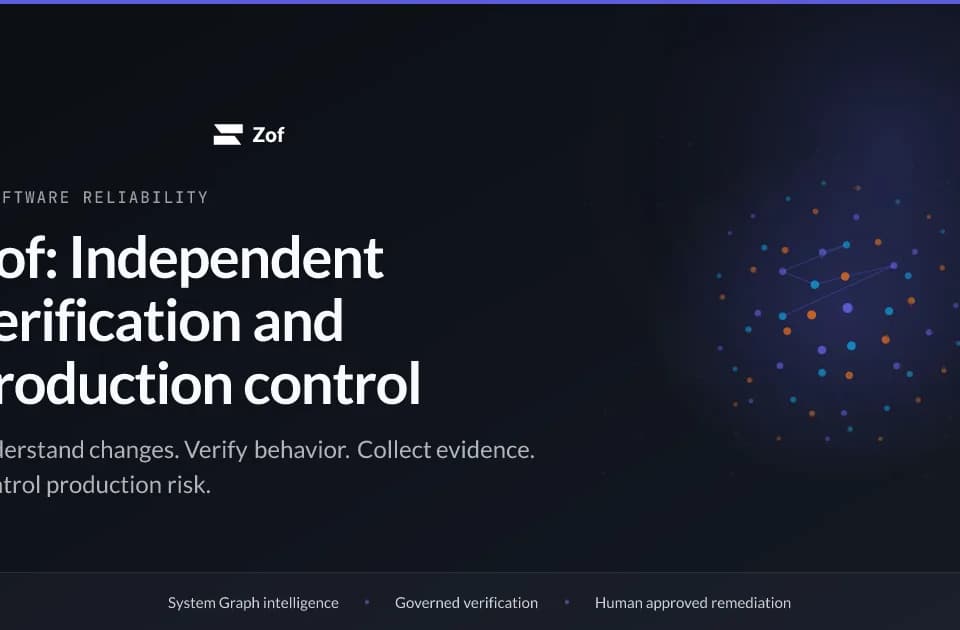
Zof adds verification evidence and policy controls to AI-written changes
Zof presents an independent verification and control layer between AI-generated changes and production. Its intended users include engineering leaders, SRE, QA, security and compliance teams that need to understand a proposed change and preserve the evidence behind a release decision.
Connect the change to the system it affects
The product describes a System Graph covering services, data, owners and history. A Verification Engine selects checks for a change, while the evidence layer records what changed, what was checked and who approved it. The control layer can allow an action, block it or require a named person's approval under the customer's policy.
The homepage demonstrates this with an illustrative change to sign-in code. It explicitly labels the sample sequence and says its numbers are not a customer result. They should not be used as a measured reliability improvement.
Inspect what the evidence actually establishes
Zof advertises typed, exportable evidence for detections, approvals and remediation, alongside identity controls through RBAC and SSO. It positions approval rules, change windows and rollback paths as explicit parts of the process.
A useful evaluation would follow one real proposed change through that process. Check which risks were considered, which tests ran, which assumptions remained and how the recorded approval relates to the exact change. The presence of a report should not be treated as a guarantee that every failure mode has been found or that a legal compliance requirement has been satisfied.
Match the deployment to the trust boundary
The publisher describes deployment inside a customer's cloud, VPC, on-premises or air-gapped environment, with a zero-data-retention option. Those are vendor-described deployment choices whose details should be established for the intended installation.
The offered starting point is a paid Reliability Sprint on one critical system, typically producing findings within seven days, or a scoped demonstration. Treat that timing as the advertised engagement format. Use a representative system and a concrete release decision to judge whether its checks and evidence improve the team's current process.