
Noveum.ai: trace, evaluate and investigate production AI agents
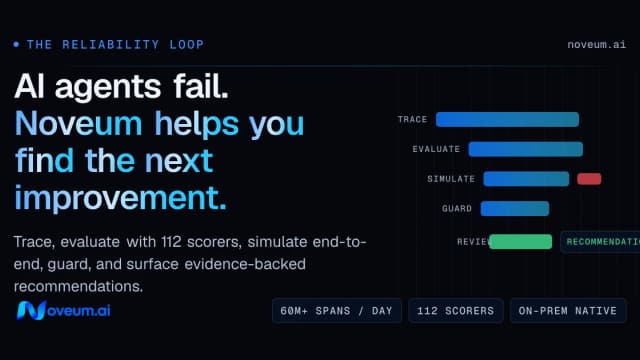
Noveum connects agent traces, selected evaluation scorers and failure analysis, leaving engineers to implement and verify the resulting recommendations.
Orbi coordinates coding, a separate review session and repository release steps, with a self-hosted core and a managed cloud option.
Orbi coordinates an AI development workflow around GitHub issues. It is designed to take a specified task through implementation, review and the repository's merge and release process, with the public GitHub record serving as evidence of the work.
The documented flow begins with an issue labeled ai-ready. Orbi implements it in an isolated worktree, then uses a separate session to review the change against the issue's acceptance criteria. That reviewer can make repairs and rerun the test suite.
The product emphasizes tying the review result to the exact commit that merges. Its recovery approach uses the issue, pull request, labels, journal and run identity to reconstruct interrupted work. These are useful features for teams who want an agent to handle a bounded backlog item rather than assist only while someone is editing.
Orbi's FAQ says normal pull requests, branch protection, required checks and human approvals still apply. That gives a team familiar places to inspect and constrain a delivery. The value of a separate AI review session still depends on the quality of the acceptance criteria and tests; it does not establish that a change is safe merely because another agent accepted it.
A practical pilot should use a small repository task with a clear expected outcome. Inspect the implementation, the review's repairs and the final test results before broadening the scope.
The core is open source under AGPL-3.0, and the site offers self-hosting with a model supplied through the user's own configuration. The managed cloud option requires GitHub authorization and app installation and includes model usage in its plans.
Check the current setup guide for platform and dependency requirements. Self-hosting determines where the runner operates, while the chosen model endpoint and repository access determine additional data flows. Public delivery examples demonstrate specific projects, rather than a guaranteed unattended success rate for a different codebase.
Before you try it
The publisher says work lands as a normal GitHub pull request and existing branch protection, required checks and human approvals still apply. It describes a separate AI review session that can repair changes and retest the repaired commit before merge.
Official sourceNo. The page says self-hosting has no platform fee, while model spending goes to the user's selected provider. A local model or compatible API can be used; the managed Cloud offer instead includes model usage in its plans.
Official sourceIts recovery model reconstructs state from the GitHub issue, pull request, labels, journal and run ID. The described restart resumes the same run, branch, worktree and PR rather than creating a separate delivery; this is the publisher's workflow, not a guarantee from an independent failure test.
Official sourceNoveum connects agent traces, selected evaluation scorers and failure analysis, leaving engineers to implement and verify the resulting recommendations.

A control-plane service for registering agents, checking proposed actions and retaining an audit trail.

Bring an agent, browser, terminal and editor together, with explicit tool controls and remote access options.

Miko connects issues and team messages to coding agents, runs tasks in separate Git worktrees and returns progress and pull requests for review.

Kynage organizes agent work around repositories, scoped tickets, common instructions and retained project knowledge.

Lispa coordinates agents around a repository task, with visible changes, checks and usage before a team decides what ships.