
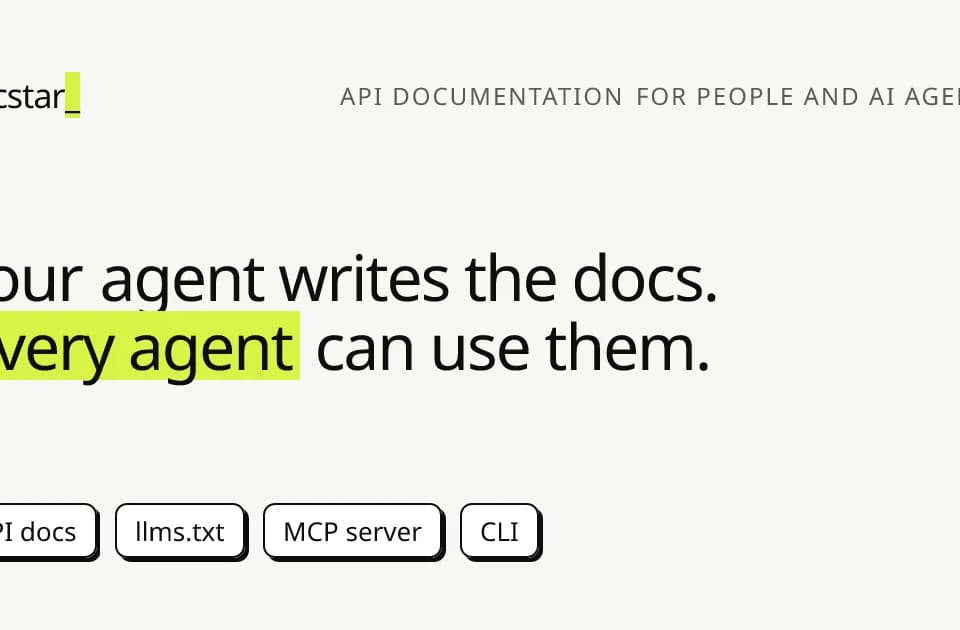
DocStar turns API code into documentation, MCP access and a CLI
DocStar is an API documentation platform designed for people and agents. The official page describes a coding agent reading an API repository, proposing documentation and publishing several interfaces from that shared description.
Start with the repository
The workflow begins in a coding agent with access to the API's code. The agent identifies routes, authentication, parameters, bodies and responses, groups them into modules and presents a plan before writing.
DocStar says an OpenAPI file is not required for that path, although an existing OpenAPI or Postman file can be imported. That makes the repository a starting source, not a reason to skip checking whether the generated description matches the running API.
Several ways to use the same information
The outputs include a human-readable docs site, Markdown and llms.txt, a hosted MCP server, a CLI and an OpenAPI file. Custom domain and branding options are described for the documentation and agent-facing channels.
An MCP server that exposes API actions has different consequences from a static reference page. Review the authentication and the actions being made available before connecting a client to a real account.
Keeping documentation aligned
The service describes watching the repository for changes, flagging drift and drafting fixes linked to the relevant pull request. It also collects questions that an agent could not answer from the documentation.
The default described flow uses drafts and human publication decisions; auto-publish can be enabled for a project. Choose that behavior deliberately rather than assuming every detected change will be correct.
A useful first check
Document one small module, compare its route and authentication details with the code, and test the resulting reference and client behavior. The useful outcome is consistent, usable API information across channels. An attractive generated page alone does not establish that all examples, permissions and responses are accurate.