
Facesage
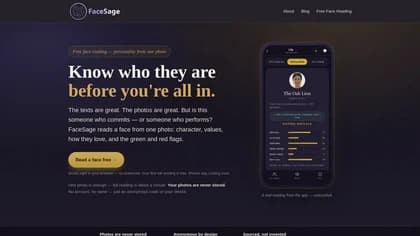
FaceSage is a browser-based app that creates entertainment-oriented personality readings from facial photos. The FaceSage website describes a workflow that combines on-device facial measurements, face-reading traditions, first-impression research, and AI-generated text.
What it does
Users upload a clear, front-facing photo from a phone or computer, verify an email address, and receive a personality reading without downloading an app. FaceSage says its device-based process detects 478 facial landmarks and measures features such as eye spacing and face shape. It may also create a smaller image copy to assess details such as eyebrow thickness.
The service offers a first full personality reading and one follow-up question for free after email verification. Paid options include dating and friendship readings, two-person matches, and additional readings. The site lists individual packages at $4.99 for one reading, $11.99 for three, and $29.99 for ten. FaceSage Plus is listed at $8.49 per week or $59.99 per year; the vendor says Plus includes three new readings per week, with unused readings rolling over up to nine. Prices are in U.S. dollars, and tax may be added at checkout. (Pricing and product details)
Who it helps
FaceSage is for people seeking a photo-based personality-reading experience for entertainment. Its dating, friendship, and two-person match formats provide different types of readings, and its browser-based access does not require installing software.
Notable capabilities
- Generates a personality reading from a facial photo.
- Uses facial-landmark measurements, including face shape and eye spacing, as inputs to the reading process.
- Provides a follow-up question with the initial free reading.
- Offers dating, friendship, and two-person match reading formats.
- Supports one-time reading bundles and FaceSage Plus plans.
How it works
A typical session consists of uploading a suitable image, allowing the app to measure facial features, and reviewing the generated reading. Readings do not expire, according to the product information. The privacy policy identifies Anthropic’s Claude as the AI writing provider and states that full-resolution originals are not retained. Downscaled copies are normally deleted from FaceSage’s server within 48 hours, while completed readings may remain for up to seven days. (Privacy policy)
Strengths and limits
The service offers no-download browser access, a photo-based process, a free initial reading, and individual or two-person formats. FaceSage explicitly says its readings are entertainment and are not scientific personality tests. They cannot establish a person’s true character, feelings, or future behavior. Results should therefore be treated as generated interpretations rather than verified assessments, especially when considering another person from their photograph.