
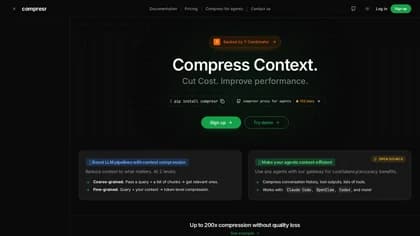
Compresr.ai
Compresr is a context-compression API for developers working with language models. You send long text and the question it needs to answer; Compresr selects relevant spans and returns shorter context for the model. Its introduction places this step ahead of an existing model stack, so the compression service does not replace the model that produces your answer.
Compress for the question
Compresr uses the query to decide which text to retain. The documented uses include retrieved chunks in RAG, growing conversation history, and noisy agent tool results. For a tool response, the publisher recommends supplying the tool call's intent as the query. This ties compression to the task the agent was trying to complete.
Every call requires the context, the query, and a compression model name. The captured documentation identifies latte_v1 as stable and latte_v2 and latte_v2.1 as beta. It describes a dynamic mode in latte_v2 that chooses a compression ratio for each input.
Connect it to a development workflow
The service provides Python and TypeScript clients. The documentation also describes a cURL request and integrations for LangChain, LangGraph, LlamaIndex, and LiteLLM. The integrations cover different locations in an application, including retrieved documents, tool output, conversation memory, and state transfers.
Choose the point where your application accumulates long context, then assess whether the compressed text still preserves the information needed by that query. Compression can remove material you would need for a later, different question, so the query and the original context remain important inputs to the workflow.
Deployment, pricing, and accuracy tradeoffs
Compresr offers a hosted SDK and an on-premises deployment inside your own network. The homepage says playground signup is available, while API keys are enabled after a short call with the team. The pricing page lists custom enterprise pricing sized to the workload rather than a public per-token rate.
The publisher presents benchmark results at light compression and explicitly suggests stronger compression when cost matters more than peak accuracy. Those figures describe its reported tests, not a guarantee for your documents. Evaluate answer coverage at the ratio you intend to use, particularly if the task depends on exact wording or several facts spread across a long file.