
Vezlo
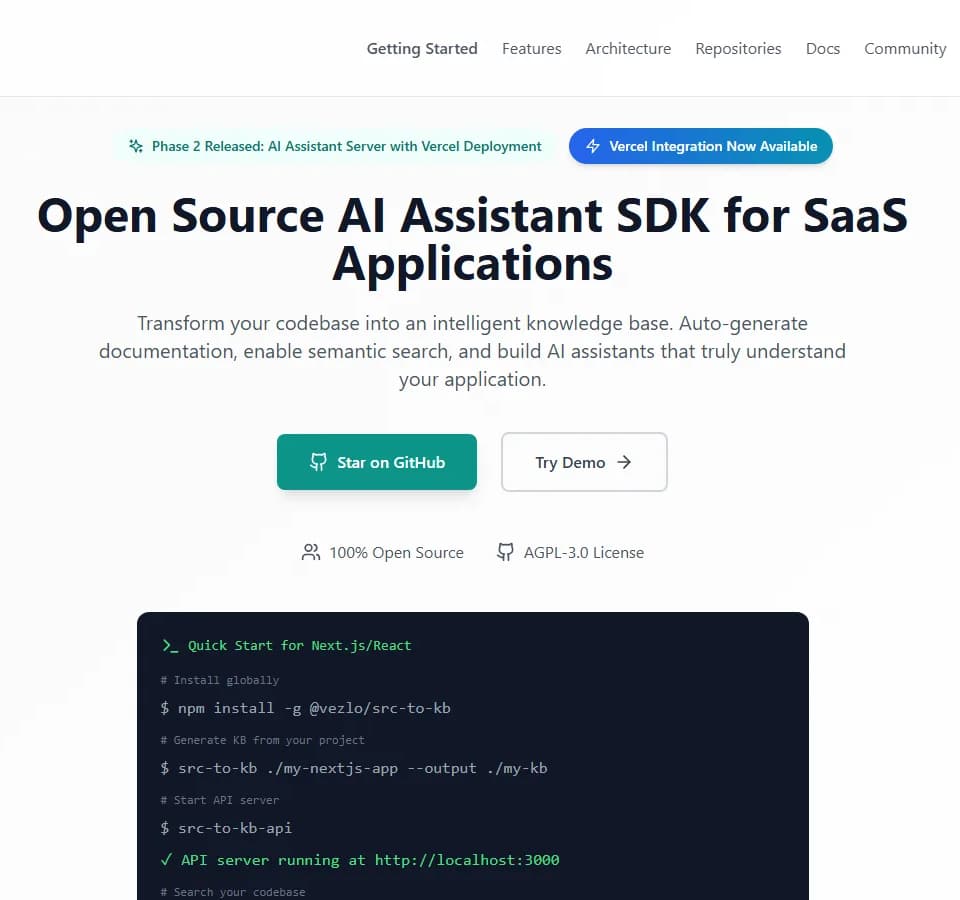
Vezlo is an open-source AI assistant SDK for SaaS applications that turns a software repository into a searchable knowledge base. The project’s documented workflow combines source-code analysis, generated documentation, semantic search, an API server, and optional frontend components for building developer, onboarding, internal knowledge, or customer-facing assistants. Vezlo is a standalone project rather than an official product from OpenAI, Anthropic, or another model provider. (Vezlo)
What it does
Vezlo’s src-to-kb package analyzes source code with abstract-syntax-tree parsing rather than treating the repository as plain text. According to the project, it can identify code structure, dependencies, relationships, and patterns across JavaScript, TypeScript, Python, Go, Rust, and other languages. It then generates documentation, metadata, and vector embeddings for semantic search.
A typical command-line workflow is to install @vezlo/src-to-kb, point it at a project directory, and write the resulting knowledge base to an output folder:
bash
src-to-kb ./my-nextjs-app --output ./my-kb
Users can query the generated data with natural-language searches such as “How does routing work?” or “Where are the API routes defined?” The documentation also lists an MCP server for querying through tools such as Claude Code or Cursor, although the supplied material does not document its configuration in detail.
Who it helps
Vezlo is aimed primarily at teams that need an assistant grounded in their own codebase. Documented use cases include code-question-and-answer agents, onboarding assistants, internal semantic search across repositories, architectural documentation, API documentation, and code summaries.
Developers can use only the knowledge-base generator for analysis and documentation, or combine it with the rest of the platform. The project describes a Node.js/TypeScript assistant server that exposes REST endpoints for queries, search, and feedback, alongside Socket.io-based WebSocket chat with persistent conversation history and message ratings.
Workflow and deployment
The documented full-stack sequence is:
- Generate a knowledge base from the repository.
- Start
assistant-serverwith the knowledge-base path. - Connect a frontend using
assistant-client-js. - Optionally embed the React-based
assistant-chatwidget.
The JavaScript client is described as framework-agnostic, with async APIs, WebSocket support, automatic reconnection, and TypeScript definitions. For deployment, Vezlo documents local development, self-hosting with Docker and user-managed infrastructure, and a web-based Vercel integration intended to automate setup and deployment without requiring the CLI.
Strengths and limits
Vezlo’s main strength is its repository-oriented architecture: AST analysis, generated documentation, vector search, REST APIs, WebSocket conversations, and frontend components are separated into reusable projects. This can support anything from a local code-search tool to a broader SaaS assistant.
The project presents an ai-validator component for source attribution, factual checking, confidence scoring, and hallucination detection. However, its roadmap also labels response validation as a planned phase, so teams should verify the validator’s current maturity before treating it as production assurance. Vezlo states that major components use the AGPL-3.0 license for non-commercial use and that commercial licenses are available; no consolidated commercial pricing is published on the official site.