
CodeProt
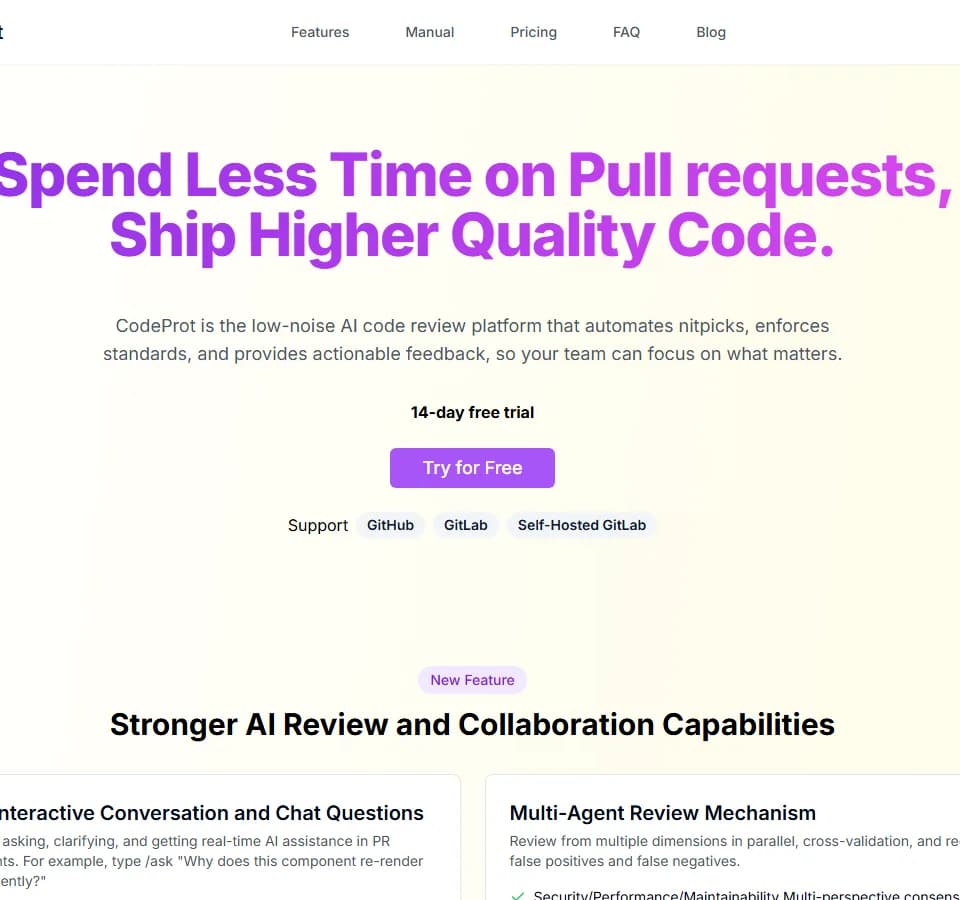
CodeProt is an AI-assisted code review and static analysis platform for teams that want automated feedback on pull and merge requests, repository-wide scanning, and centralized code-quality governance. The vendor positions it as a “low-noise” review tool that focuses on security, performance, maintainability, and actionable fixes. CodeProt advertises a 14-day free trial; no other pricing details are provided on its official website.
What it does
CodeProt reviews changed code alongside surrounding context, including potential upstream and downstream effects, rather than examining only the edited lines. Its documented review capabilities include:
- Security vulnerability detection
- Performance analysis and optimization suggestions
- Maintainability and code-quality checks
- Refactoring and duplication recommendations
- Architecture and design-pattern checks
- Team-specific coding-standard enforcement
The platform supports an interactive /ask command for questions in pull-request comments. Teams can use it to clarify a finding, discuss architecture, or investigate debugging questions, with session tracking and context memory described as supported capabilities.
A multi-agent review mechanism analyzes changes from security, performance, and maintainability perspectives in parallel. CodeProt says it cross-validates findings, merges conflicting suggestions, and deduplicates overlapping comments.
For broader analysis, repository scans examine the entire codebase for bugs, vulnerabilities, compliance gaps, performance bottlenecks, duplication, and maintainability issues. Scan results can be categorized by severity and tracked through connected issue-management systems.
Workflow
CodeProt’s setup flow starts by authorizing GitHub, installing the CodeProt GitHub App, selecting repositories, and enabling automatic reviews for pull requests. Review settings can optionally include lint rules and other repository-specific preferences. The site also lists support for GitLab and self-hosted GitLab.
Reviews can be incremental: CodeProt says it limits suggestions to changed ranges and provides patches that can be applied to commits. Users can apply suggestions individually or in batches. The platform also describes organization-, repository-, and branch-level governance for rules, thresholds, exemptions, and merge-blocking baselines, with approval and audit tracking for exceptions.
For issue-focused reviews, CodeProt documents integrations with Jira, Linear, and Leiga. Teams can reference an issue key in a commit message, then have the AI compare the code change with the reported defect and its context. Findings from pull-request reviews or repository scans can be linked to existing issues or used to create new ones.
Strengths and limits
CodeProt’s documented strengths are its combination of pull-request review, repository scanning, one-click fix suggestions, interactive Q&A, and governance controls. Its change-context analysis and deduplication are particularly relevant for teams trying to reduce repetitive review comments.
The vendor claims 94% precision, 87% noise reduction, and a 3.2× signal-to-noise ratio, citing independent testing on enterprise codebases. These figures are vendor-reported and should not be treated as independently verified results. Similarly, claims about zero data retention, temporary review environments, encryption, and enterprise security are stated on the product site but are not accompanied in the supplied material by technical specifications or third-party certifications. Teams should validate language support, repository permissions, CI behavior, retention terms, and governance requirements before adoption.