
Emix
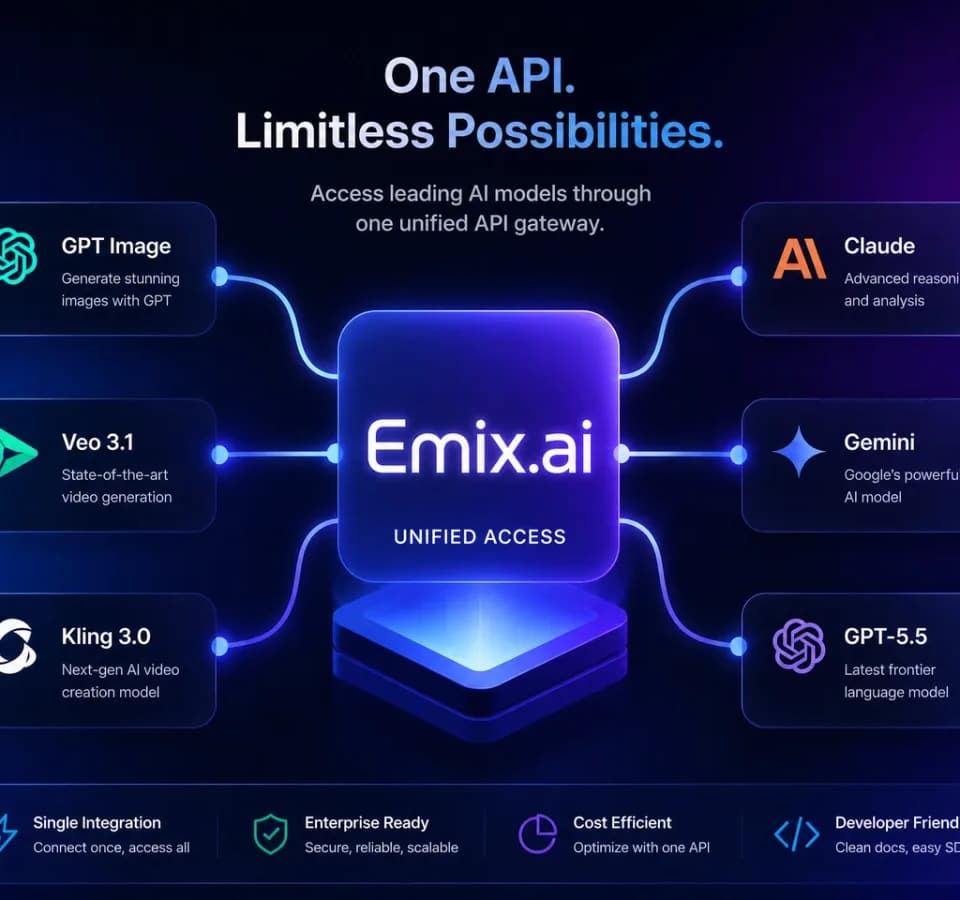
Emix.ai is a developer-facing API platform that presents access to image, video, audio, chat, and enhancement models through one gateway. Its homepage emphasizes testing and usage-based pricing rather than a single creative application. That makes the integration contract, available model endpoints, and per-request charges central to evaluating it.
Integrate a gateway, then verify each endpoint
Emix describes a unified API across multiple providers and model categories. Its homepage also advertises free testing credits, API Sandbox access, and webhook support. Those features may help a developer evaluate a request before adding it to an application, but the captured page does not establish exact schemas, authentication details, or webhook-delivery guarantees.
For an LLM-only integration, OurToken.ai describes a similar consolidation approach through an OpenAI-compatible API shape. Emix's stated scope also includes generated visual and audio assets. That difference in scope is useful when deciding which endpoint documentation to inspect; it is not evidence that the platforms have equivalent compatibility or reliability.
Read prices at the request level
The homepage's comparison table separates language-model input and output prices and uses different units for media, including images, videos, and seconds. A headline token rate therefore cannot describe the cost of an entire mixed-media workflow. Verify the specific model, billing unit, and output settings for the request you intend to make.
Emix advertises lower prices than official APIs. Franklin has not independently verified its provider-price comparisons, the listed model versions, or the service's access arrangements. Treat the table as the reseller's offer to check against current endpoint documentation, rather than proof of a guaranteed saving.
Confirm failure handling before production
The publisher says failed generation tasks do not consume credits and purchased credits never expire. A production integration should still establish which failure states qualify, how completion is reported, and what happens if an application retries an ambiguous request.
The retrieved homepage does not establish an uptime result or detailed data-retention terms. Test error handling and inspect the applicable terms before sending sensitive material. No Franklin benchmark of latency, output quality, or billing behavior accompanies this description.