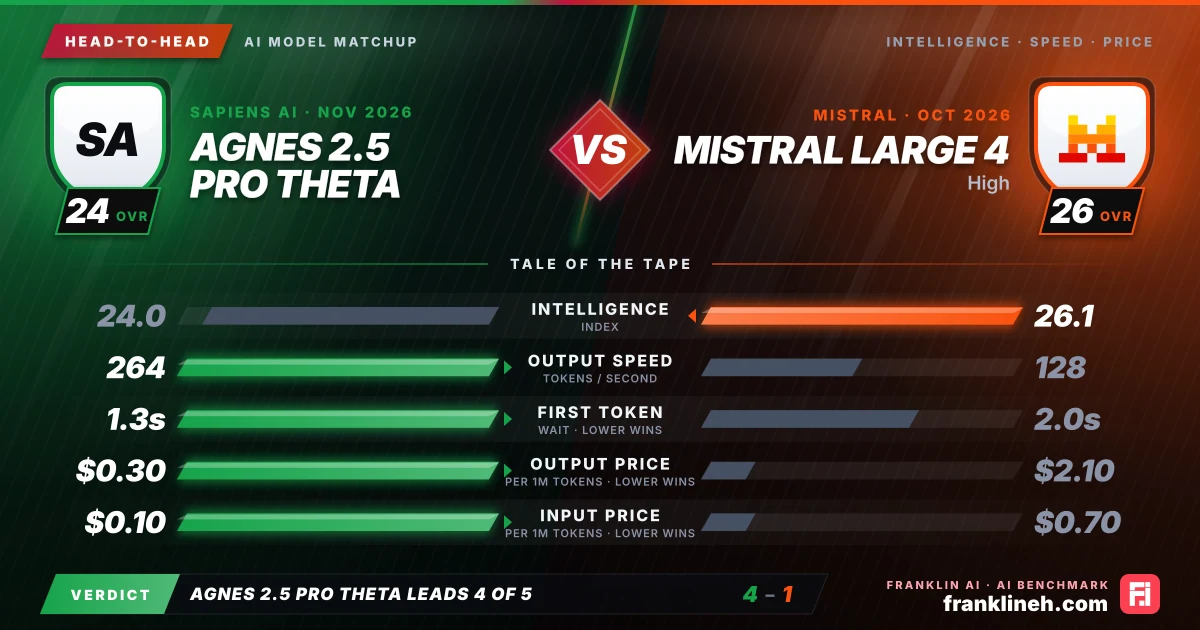
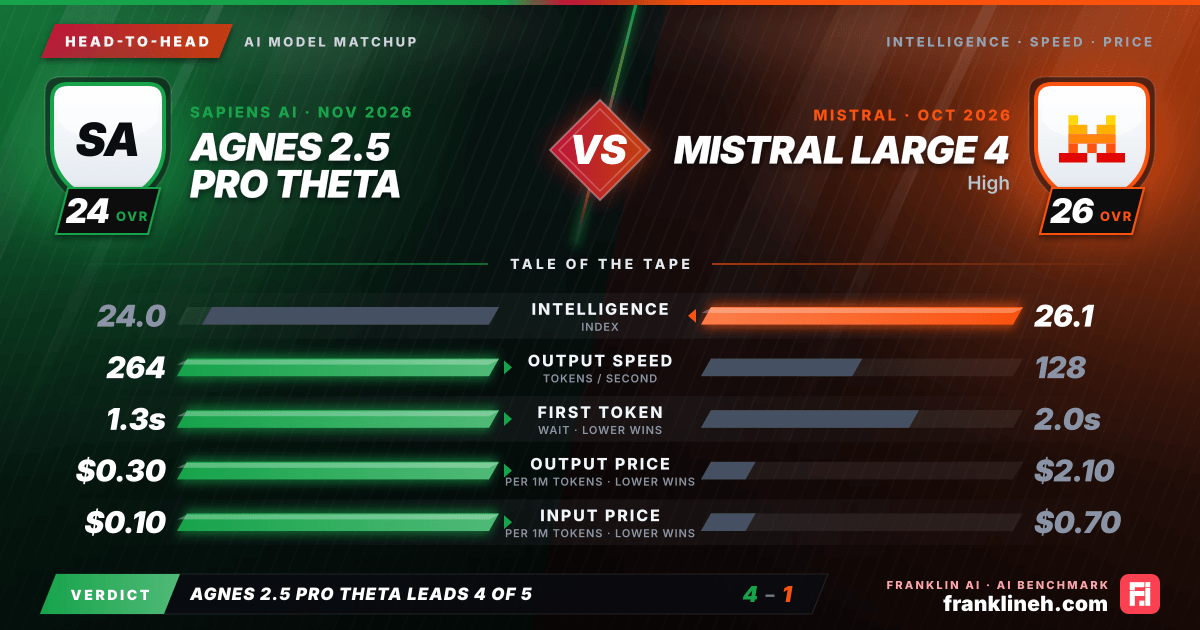
Head-to-head AI model comparison graphic: Agnes 2.5 Pro Theta (Sapiens AI) vs Mistral Large 4 (Mistral). Intelligence index 24.1 vs 26.1; output speed 191 vs 106 tokens per second; time to first token 1.6s vs 1.5s; output price $0.30 vs $2.10 per million tokens; input price $0.10 vs $0.70 per million tokens. franklineh.com
Agnes 2.5 Pro Theta vs Mistral Large 4: head-to-head AI benchmark comparison. Agnes 2.5 Pro Theta leads on output speed, output price and input price; Mistral Large 4 leads on intelligence index and time to first token.
Head to headUpdated

Agnes 2.5 Pro Theta vs Mistral Large 4 High: which is cheaper?

Mistral Large 4 High leads the intelligence index 26.1 to 24.1. Agnes 2.5 Pro Theta costs 86% less on blended price. See token costs, speed and which to pick.

Pick it for Agnes 2.5 Pro Theta

  • Lower cost: $0.16 against $1.12 for 1 million input and 200,000 output tokens.
  • Faster output once writing: 191 tokens per second against 106 tokens per second, which wins on total time beyond about 50 tokens.

Pick it for Mistral Large 4 · High

  • Higher intelligence index: 26.1 against 24.1.

By the numbers

These figures describe the two model configurations shown here. A dash means the source snapshot had no usable figure for that metric. Scores, speed and API pricing may change as providers update models.

MetricAgnes 2.5 Pro ThetaMistral Large 4 (High)
Intelligence Index24.126.1
Input price (per 1M tokens)$0.10$0.70
Output price (per 1M tokens)$0.30$2.10
Output speed (tokens/s)191106
Time to first token1.6s1.5s
Release date2026-11-072026-10-29

Agnes 2.5 Pro Theta from Sapiens AI and Mistral Large 4 (High) from Mistral land within 2.0 points of each other on the intelligence index. The sharpest difference is price: Agnes 2.5 Pro Theta costs $0.30 per million output tokens, against $2.10 for Mistral Large 4 High. No hands-on testing went into this write-up; it summarises the recorded benchmark, price and speed data for both models.

Price per token

Per million tokens, Agnes 2.5 Pro Theta charges $0.10 for input and $0.30 for output, while Mistral Large 4 High charges $0.70 and $2.10. Mistral Large 4 High costs 7 times as much per output token.

For a sample workload of 1 million input tokens and 200,000 output tokens, Agnes 2.5 Pro Theta would cost $0.16 and Mistral Large 4 High $1.12, a difference of $0.96. For classifying 100,000 short messages at 150 input tokens and 5 output tokens each, Agnes 2.5 Pro Theta would come in 86% lower: $1.65 for Agnes 2.5 Pro Theta against $11.55 for Mistral Large 4 High.

Waiting time

Agnes 2.5 Pro Theta generates about 191 tokens per second and Mistral Large 4 High about 106 tokens per second. That makes Agnes 2.5 Pro Theta roughly 1.8 times as fast at writing. Time to first token is 1.6 seconds for Agnes 2.5 Pro Theta and 1.5 seconds for Mistral Large 4 High.

For a 600-token response, first token plus generation comes to roughly 4.8 seconds on Agnes 2.5 Pro Theta and 7.1 seconds on Mistral Large 4 High. Counting that wait, Agnes 2.5 Pro Theta only pulls ahead on outputs beyond about 50 tokens.

Release timing

Mistral Large 4 High came first, on October 29, 2026; Agnes 2.5 Pro Theta followed on November 7, 2026. That is close enough to count them as the same generation.

The headline benchmark

The catalogue puts Agnes 2.5 Pro Theta at 24.1 and Mistral Large 4 High at 26.1 on its intelligence index. It is a small margin for an index that averages many evaluations. In relative terms, Mistral Large 4 High scores 8% higher.

For context, that places Agnes 2.5 Pro Theta 99th and Mistral Large 4 High 94th out of 155 scored models still on offer.

Specialist coding and math indexes are missing for both, so treat the overall score as the only capability signal here.

Is the price in proportion?

Per point of intelligence index, Agnes 2.5 Pro Theta costs $0.0062 of blended price per million tokens and Mistral Large 4 High $0.040. Mistral Large 4 High costs 6.5 times as much per point, which is the price of its lead.

Quick answers

Is Mistral Large 4 High better than Agnes 2.5 Pro Theta?

Neither wins everywhere: Mistral Large 4 High scores higher on the intelligence index, 26.1 to 24.1; Agnes 2.5 Pro Theta is 86% cheaper on blended price; and Agnes 2.5 Pro Theta streams output 1.8 times as fast.

Are Agnes 2.5 Pro Theta and Mistral Large 4 High from the same company?

Agnes 2.5 Pro Theta is made by Sapiens AI and Mistral Large 4 High by Mistral. Agnes 2.5 Pro Theta was released on November 7, 2026 and Mistral Large 4 High on October 29, 2026.

Was this comparison tested by hand?

The figures are the recorded benchmark, price and speed data in Franklin AI's model catalogue. This page is written from that data automatically; neither model was tested by hand for it.

Does Agnes 2.5 Pro Theta respond faster than Mistral Large 4 High?

Agnes 2.5 Pro Theta generates output faster, at 191 tokens per second against 106 tokens per second. Time to first token is similar: 1.6 seconds and 1.5 seconds. Counting the first-token wait, Mistral Large 4 High finishes short replies first and Agnes 2.5 Pro Theta pulls ahead beyond about 50 tokens.

Is Mistral Large 4 High cheaper than Agnes 2.5 Pro Theta?

Agnes 2.5 Pro Theta is cheaper on a blended basis. Agnes 2.5 Pro Theta lists $0.10 per million input tokens and $0.30 per million output tokens; Mistral Large 4 High lists $0.70 and $2.10. For 1 million input and 200,000 output tokens that is $0.16 against $1.12.

Final whistle

The verdict: Agnes 2.5 Pro Theta has more going for it here, but Mistral Large 4 High is not without an argument. Pick Agnes 2.5 Pro Theta if cost matters ($0.30 against $2.10 per million output tokens) and your outputs often run past about 50 tokens. Pick Mistral Large 4 High if you need the higher overall score (26.1 against 24.1).

Where the numbers come from

The scores, speed and prices in this comparison come from independent third-party model evaluations that Franklin AI syncs each day, and the article was written from a snapshot of them. For the latest results, open the Agnes 2.5 Pro Theta and Mistral Large 4 (High) pages. The AI Benchmark methodology explains how that data is collected and shown.

Comments (0)

No comments yet

Be the first to share your thoughts!