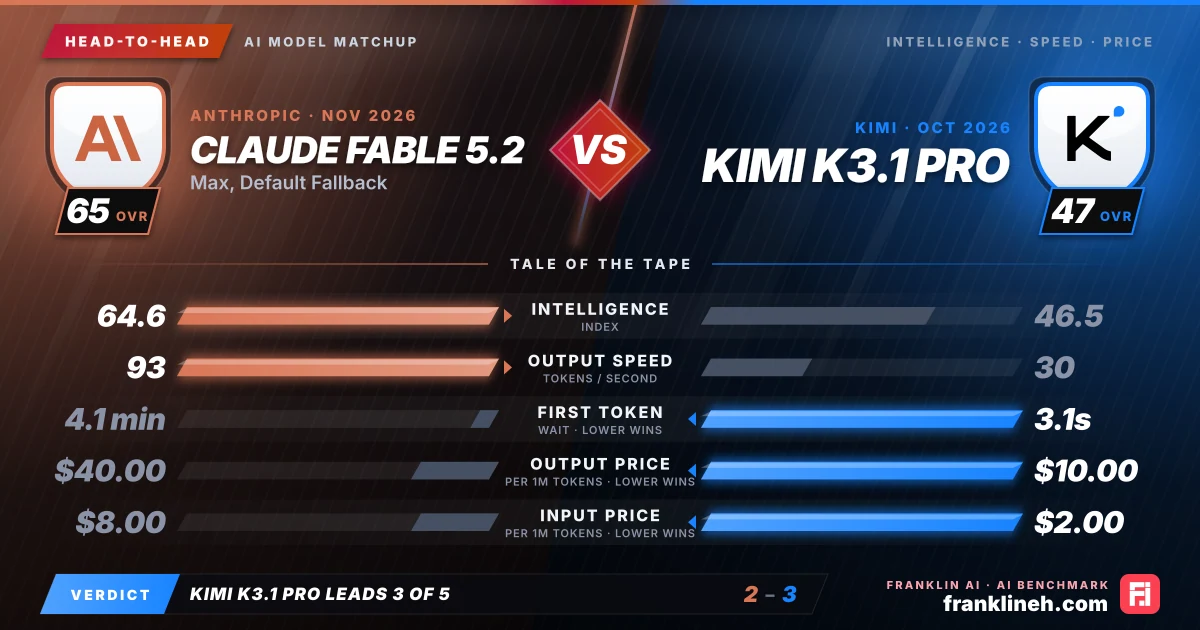
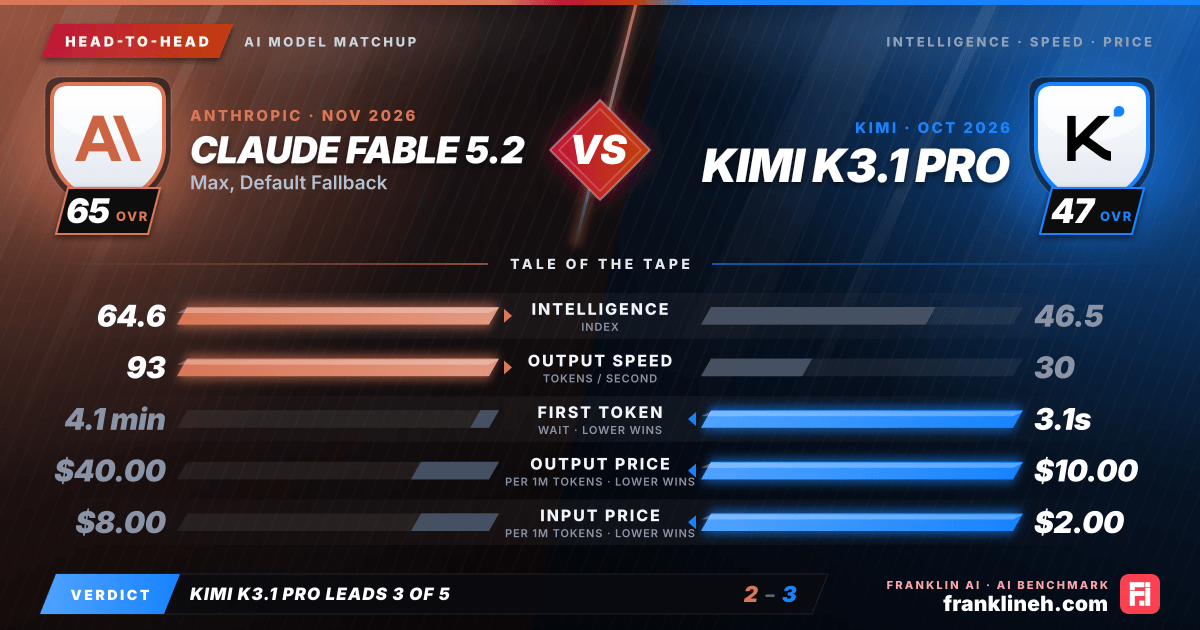
Head-to-head AI model comparison graphic: Claude Fable 5.2 (Anthropic) vs Kimi K3.1 Pro (Kimi). Intelligence index 64.8 vs 46.6; output speed 91 vs 35 tokens per second; time to first token 3.2 min vs 2.5s; output price $40.00 vs $10.00 per million tokens; input price $8.00 vs $2.00 per million tokens. franklineh.com
Claude Fable 5.2 vs Kimi K3.1 Pro: head-to-head AI benchmark comparison. Kimi K3.1 Pro leads on time to first token, output price and input price; Claude Fable 5.2 leads on intelligence index and output speed.
Head to headUpdated

Claude Fable 5.2 Max vs Kimi K3.1 Pro compared

Claude Fable 5.2 Max leads the intelligence index 64.8 to 46.6. Kimi K3.1 Pro costs 75% less on blended price. See token costs, speed and which to pick.

Pick it for Claude Fable 5.2 · Max, Default Fallback

  • Higher intelligence index: 64.8 against 46.6.
  • Higher throughput once writing (91 tokens per second against 35 tokens per second), though it only finishes first beyond about 11,000 tokens.

Pick it for Kimi K3.1 Pro

  • Shorter wait for the first token: 2.5 seconds against 3.2 minutes.
  • Lower cost: $4.00 against $16.00 for 1 million input and 200,000 output tokens.
  • Finishes a typical reply sooner: about 31 seconds against 3.3 minutes for 1,000 tokens, counting the first-token wait.

By the numbers

These figures describe the two model configurations shown here. A dash means the source snapshot had no usable figure for that metric. Scores, speed and API pricing may change as providers update models.

MetricClaude Fable 5.2 (Max, Default Fallback)Kimi K3.1 Pro
Intelligence Index64.846.6
Input price (per 1M tokens)$8.00$2.00
Output price (per 1M tokens)$40.00$10.00
Output speed (tokens/s)9135
Time to first token3.2 min2.5s
Release date2026-11-092026-10-23

Claude Fable 5.2 (Max, Default Fallback) from Anthropic and Kimi K3.1 Pro from Kimi sit in different tiers of the catalogue. Claude Fable 5.2 Max leads the intelligence index 64.8 to 46.6, a gap of 18.2 points. All numbers are the catalogue's recorded values; nobody ran either model by hand for this page.

Benchmark scores

On the intelligence index, Claude Fable 5.2 Max scores 64.8 against 46.6 for Kimi K3.1 Pro. A gap this large suggests the two are built for different jobs. In relative terms, Claude Fable 5.2 Max scores 39% higher.

For context, that places Claude Fable 5.2 Max 1st and Kimi K3.1 Pro 42nd out of 155 scored models still on offer.

For coding or maths work specifically, the catalogue has no dedicated index on either side yet.

Waiting time

Once a response is under way, Claude Fable 5.2 Max produces roughly 91 tokens per second against 35 tokens per second for Kimi K3.1 Pro. Claude Fable 5.2 Max is ahead by 160% on throughput. Before any text appears, Claude Fable 5.2 Max takes 3.2 minutes and Kimi K3.1 Pro 2.5 seconds. Claude Fable 5.2 Max writes faster once it starts, but Kimi K3.1 Pro's head start is large enough that Kimi K3.1 Pro still finishes first at any typical reply length; Claude Fable 5.2 Max only catches up beyond about 11,000 tokens. A first-token wait of that length suits background work better than live conversation.

For a 1,000-token response, first token plus generation comes to roughly 3.3 minutes on Claude Fable 5.2 Max and 31 seconds on Kimi K3.1 Pro.

Which is newer

Kimi K3.1 Pro came first, on October 23, 2026; Claude Fable 5.2 Max followed on November 9, 2026. They are effectively contemporaries.

Token pricing and a sample bill

Per million tokens, Claude Fable 5.2 Max charges $8.00 for input and $40.00 for output, while Kimi K3.1 Pro charges $2.00 and $10.00. Claude Fable 5.2 Max costs 4 times as much per output token.

Take 1 million input tokens and 200,000 output tokens: that comes to $16.00 on Claude Fable 5.2 Max and $4.00 on Kimi K3.1 Pro. A bigger example, a support assistant answering 10,000 conversations of 2,000 input and 500 output tokens each, costs $360 on Claude Fable 5.2 Max and $90.00 on Kimi K3.1 Pro: a gap of $270. On a 3:1 blend of input to output tokens, that works out to $16.00 versus $4.00 per million.

Cost per point of intelligence

Per point of intelligence index, Claude Fable 5.2 Max costs $0.25 of blended price per million tokens and Kimi K3.1 Pro $0.086. Claude Fable 5.2 Max costs 2.9 times as much per point, which is the price of its lead.

Common questions about Claude Fable 5.2 Max and Kimi K3.1 Pro

Is Kimi K3.1 Pro better than Claude Fable 5.2 Max?

Not across the board: Claude Fable 5.2 Max scores higher on the intelligence index, 64.8 to 46.6; Kimi K3.1 Pro is 75% cheaper on blended price; Claude Fable 5.2 Max streams output 2.6 times as fast; and Kimi K3.1 Pro reaches its first token sooner.

Are Claude Fable 5.2 Max and Kimi K3.1 Pro from the same company?

Claude Fable 5.2 Max is made by Anthropic and Kimi K3.1 Pro by Kimi. Claude Fable 5.2 Max was released on November 9, 2026 and Kimi K3.1 Pro on October 23, 2026.

Which model has lower latency?

Claude Fable 5.2 Max generates output faster, at 91 tokens per second against 35 tokens per second. Kimi K3.1 Pro reaches its first token sooner (2.5 seconds against 3.2 minutes). Counting the first-token wait, Kimi K3.1 Pro finishes first for any reply shorter than about 11,000 tokens.

When were Claude Fable 5.2 Max and Kimi K3.1 Pro released?

Claude Fable 5.2 Max is newer. It was released on November 9, 2026, 17 days after Kimi K3.1 Pro (October 23, 2026).

Where do these numbers come from?

The figures are the recorded benchmark, price and speed data in Franklin AI's model catalogue. This page is written from that data automatically; neither model was tested by hand for it.

Final whistle

In one line: it is close, with Claude Fable 5.2 Max and Kimi K3.1 Pro each holding a real advantage. Pick Claude Fable 5.2 Max if you need the higher overall score (64.8 against 46.6) and you generate very long outputs, beyond about 11,000 tokens. Pick Kimi K3.1 Pro if users are waiting on the first word and cost matters ($10.00 against $40.00 per million output tokens).

Where the numbers come from

The scores, speed and prices in this comparison come from independent third-party model evaluations that Franklin AI syncs each day, and the article was written from a snapshot of them. For the latest results, open the Claude Fable 5.2 (Max, Default Fallback) and Kimi K3.1 Pro pages. The AI Benchmark methodology explains how that data is collected and shown.

Comments (0)

No comments yet

Be the first to share your thoughts!